Of the Severall Subjects of Knowledge
There are of Knowledge two kinds; whereof one is Knowledge of Fact: the other Knowledge of the Consequence of one Affirmation to another. The former is nothing else, but Sense and Memory, and is Absolute Knowledge; as when we see a Fact doing, or remember it done: And this is the Knowledge required in a Witnesse. The later is called Science; and is Conditionall; as when we know, that, If the figure showne be a Circle, then any straight line through the Center shall divide it into two equall parts. And this is the Knowledge required in a Philosopher; that is to say, of him that pretends to Reasoning.
The Register of Knowledge of Fact is called History. Whereof there be two sorts: one called Naturall History; which is the History of such Facts, or Effects of Nature, as have no Dependance on Mans Will; Such as are the Histories of Metalls, Plants, Animals, Regions, and the like. The other, is Civill History; which is the History of the Voluntary Actions of men in Common-wealths.
The Registers of Science, are such Books as contain the Demonstrations of Consequences of one Affirmation, to another; and are commonly called Books of Philosophy; whereof the sorts are many, according to the diversity of the Matter; And may be divided in such manner as I have divided them in the following Table.
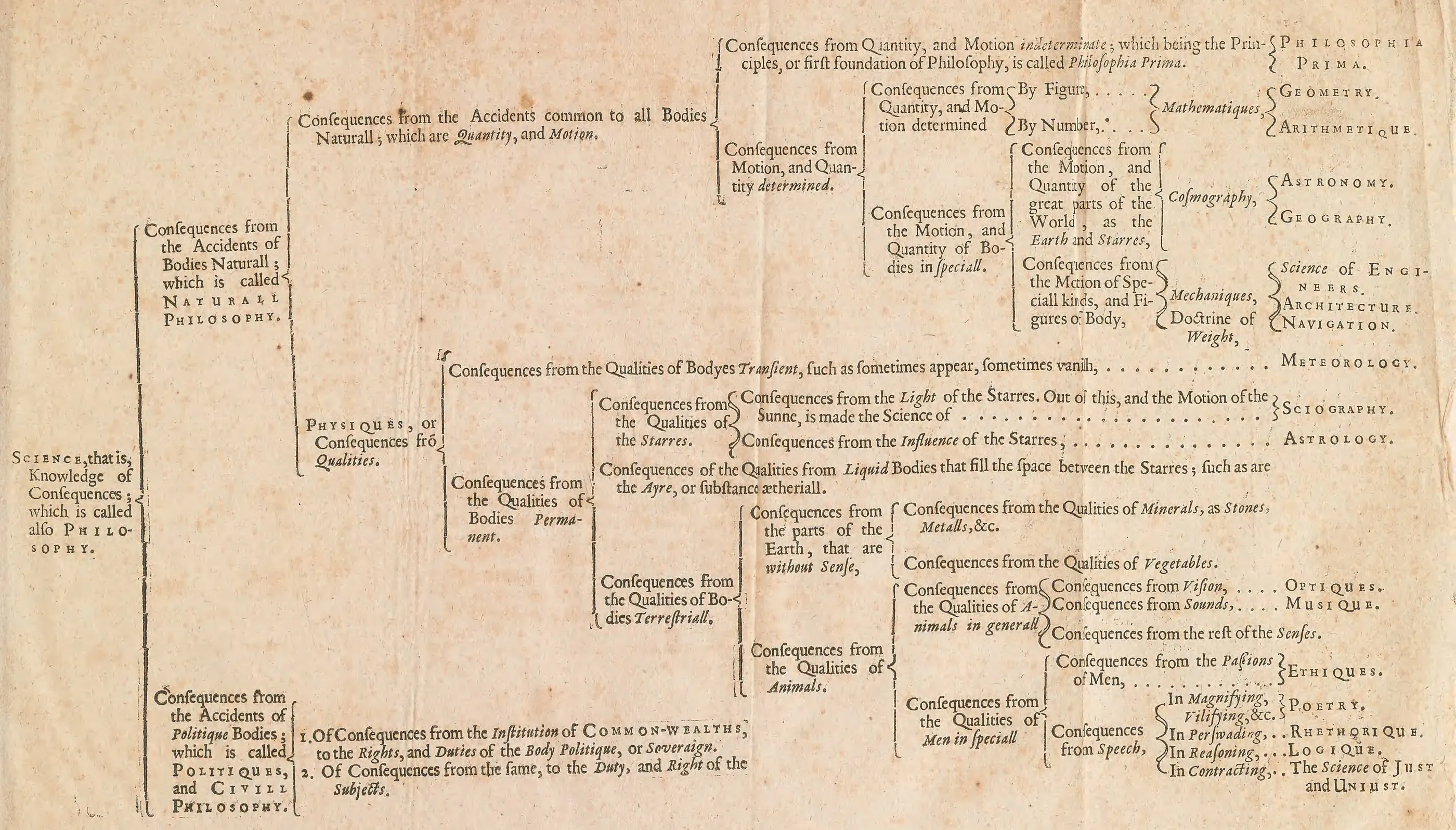
Science, that is, Knowledge of Consequences; which is called also Philosophy.
Consequences from the Accidents of Bodies Naturall; which is called Naturall Philosophy.
Consequences from the Accidents common to all Bodies Naturall; which are Quantity, and Motion.
Consequences from Quantity, and Motion indeterminate; which being the Principles, or first foundation of Philosophy, is called Philosophia Prima.
Philosophia Prima.
Consequences from Motion, and Quantity determined.
Consequences from Quantity, and Motion determined
By Figure, By Number,
Mathematiques,
Geometry.
Arithmetique.
Consequences from the Motion, and Quantity of Bodies in speciall.
Consequences from the Motion, and Quantity of the great parts of the World, as the Earth and Starres,
Cosmography,
Astronomy.
Geography.
Consequences from the Motion of Speciall kinds, and Figures of Body,
Mechaniques,
Science of Engineers.
Architecture.
Navigation.
Doctrine of Weight,
Physiques, or Consequences from Qualities.
Consequences from the Qualities of Bodyes Transient, such as sometimes appear, sometimes vanish, Meteorology.
Consequences from the Qualities of Bodies Permanent.
Consequences from the Qualities of the Starres.
Consequences from the Light of the Starres. Out of this, and the Motion of the Sunne, is made the Science of Sciography.
Consequences from the Influence of the Starres, Astrology.
Consequences of the Qualities from Liquid Bodies that fill the space between the Starres; such as are the Ayre, or substance ætheriall.
Consequences from the Qualities of Bodies Terrestriall.
Consequences from the parts of the Earth, that are without Sense,
Consequences from the Qualities of Minerals, as Stones, Metalls, &c.
Consequences from the Qualities of Vegetables.
Consequences from the Qualities of Animals.
Consequences from the Qualities of Animals in generall
Consequences from Vision, Optiques.
Consequences from Sounds, Musique.
Consequences from the rest of the Senses.
Consequences from the Qualities of Men in speciall
Consequences from the Passions of Men, Ethiques.
Consequences from Speech,
In Magnifying, Vilifying, &c. Poetry.
In Perswading, Rhethorique.
In Reasoning, Logique.
In Contracting, The Science of Just and Unjust.
Consequences from the Accidents of Politique Bodies; which is called Politiques, and Civill Philosophy.
1. Of Consequences from the Institution of Common-wealths, to the Rights, and Duties of the Body Politique, or Soveraign.
2. Of Consequences from the same, to the Duty, and Right of the Subjects.