A Supplement to the Essay on Indian Chronology
Our ingenious associate Mr. Samuel Davis, whom I name with respect and applause, and who will soon, I trust, convince M. Bailly, that it is very possible, for an European to translate and explain the Súrya Siddhánta, favoured me lately with a copy, taken by his Pandit, of the original passage, mentioned in his paper on the Astronomical Computations of the Hindus, concerning the places of the colures in the time of Varaˊha, compared with their position in the age of a certain Muni, or ancient Indian philosopher; and the passage appears to afford evidence of two actual observations, which will ascertain the chronology of the Hindus, if not by rigorous demonstration, at least by a near approach to it.
The copy of the Váráhísaṅhità, from which the three pages, received by me, had been transcribed, is unhappily so incorrect (if the transcript itself was not hastily made) that every line of it must be disfigured by some gross errour; and my Pandit, who examined the passage carefully at his own house, gave it up as inexplicable; so that, if I had not studied the system of Sanscrit prosody, I should have laid it aside in despair: but though it was written as prose, without any sort of distinction or punctuation, yet, when I read it aloud, my ear caught in some sentences the cadence of verse, and of a particular metre, called Aˊryà, which is regulated (not by the number of syllables, like other Indian measures, but) by the proportion of times, or syllabick moments, in the four divisions, of which every stanza consists. By numbering those moments and fixing their proportion, I was enabled to restore the text of Varaˊha, with the perfect assent of the learned Bráhmen, who attends me; and, with his assistance, I also corrected the comment, written by Bhattoˊtpala, who, it seems, was a son of the author, together with three curious passages, which are cited in it. Another Pandit afterwards brought me a copy of the whole original work, which confirmed my conjectural emendations, except in two immaterial syllables, and except, that the first of the six couplets in the text is quoted in the commentary from a different work entitled Panchasiddhánticà: five of them were composed by Varaˊha himself, and the third chapter of his treatise begins with them.
Before I produce the original verses, it may be useful to give you an idea of the Aˊryà measure, which will appear more distinctly in Latin than in any modern language of Europe:
Tigridas, apros, thoas, tyrannos, pessima monstra, venemur:
Dic hinnulus, dic lepus male quid egerint graminivori.
The couplet might be so arranged, as to begin and end with the cadence of an hexameter and pentameter, six moments being interposed in the middle of the long, and seven in that of the short, hemistich:
Thoas, apros, tigridas nos venemur, pejoresque tyrannos:
Dic tibi cerva, lepus tibi dic male quid egerit herbivorus.
Since the Aˊryà measure, however, may be almost infinitely varied, the couplet would have a form completely Roman, if the proportion of syllabick in-
stants, in the long and short verses, were twenty-four to twenty, instead of thirty to twenty-seven:
Venor apros tigridasque, et, pessima monstra, tyrannos:
Cerva mali quid agunt herbivorusque lepus?
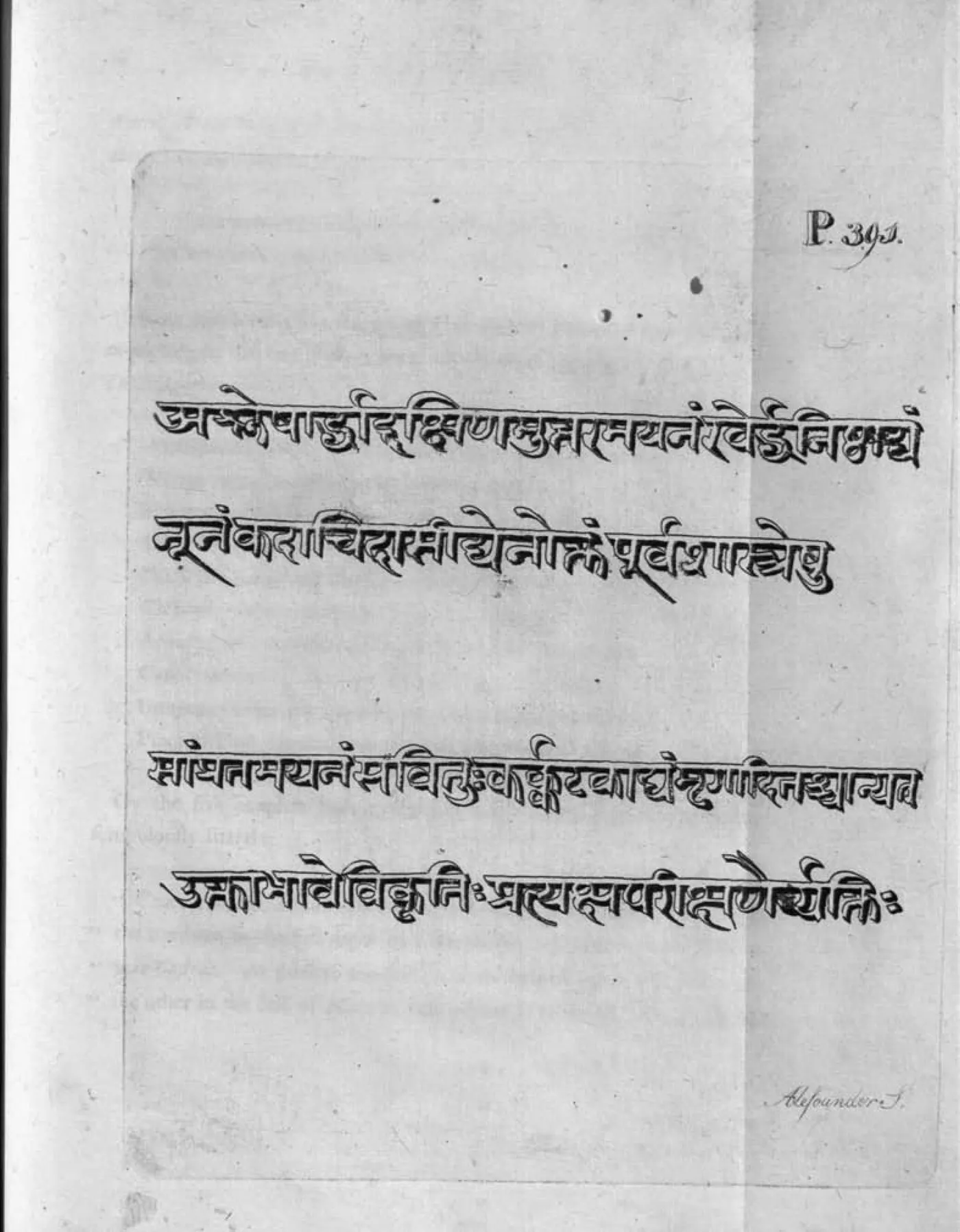
I now exhibit the five stanzas of Varaˊha in European characters, with an etching of the two first, which are the most important, in the original Dévanágarì:
Aśléshárdháddacshinamuttaramayanaṅ ravérdhanishˊt'hádyaṅ
Núnaṅ cadáchidásídyénóctaṅ púrva śastréshu.
Sámpratamayanaṅ savituh carcaˊtacádyaṅ mrĭgáditaśchányat:
Uctábhávè vicrĭtih pratyacshaperícshanair vyactih.
Dúrast'hachihnavédyádudayé'stamayé'pivà sahasráṅsóh,
Ch'háyápravéśanirgamachihnairvà maṅdálè mahati.
Aprápya macaramarcò vinivrĭttò haṅti sáparáṅ yámyáṅ,
Carcaˊtacamasaṅpráptò vinivrĭttaśchóttaráṅ saiṅdríṅ.
Uttaramayanamatítya vyávrĭttah cshémaśasya vrĭddhicarah,
Pracrĭtist'haśchápyévaṅ vicrĭtigatir bhayacridushnáṅśuh.
Of the five couplets thus exhibited, the following translation is most scrupulously literal:
“Certainly the southern solstice was once in the middle of Aśléshà, the northern in the first degree of Dhanisht'hà, by what is recorded in former Sástras. At present one solstice is in the first degree of Carcata, and the other in the first of Macara: that which is recorded, not appearing, a change must have happened; and the proof arises from ocular demonstrations; that is, by observing the remote object and its marks at the rising or setting of the sun, or by the marks, in a large graduated circle, of the shadow's ingress and egress. The sun, by turning back without having reached Macara, destroys the south and the west; by turning back without having reached Carcata, the north and east. By returning, when he has just passed the summer solstitial point, he makes wealth secure and grain abundant, since he moves thus according to nature; but the sun, by moving unnaturally, excites terrour.”
Now the Hindu Astronomers agree, that the 1st January 1790 was in the year 4891 of the Caliyuga, or their fourth period, at the beginning of which, they say, the equinoctial points were in the first degrees of Mésha and Tulà; but they are also of opinion, that the vernal equinox oscillates from the third of Mína to the twenty-seventh of Mésha and back again in 7200 years, which they divide into four pádas; and consequently that it moves, in the two intermediate pádas, from the first to the twenty-seventh of Mésha and back again in 3600 years; the colure cutting their ecliptick in the first of Mésha, which coincides with the first of Aswinì, at the beginning of every such oscillatory period. Varaˊha, surnamed Mihira, or the Sun, from his knowledge of astronomy, and usually distinguished by the title of Achárya, or teacher of the Véda, lived confessedly, when the Caliyuga was far advanced; and, since by actual observation he found the solstitial points in the first degrees of Carcata and Macara, the equinoctial points were at the same time in the first of Mésha and Tulà: he lived, therefore, in the year 3600 of the fourth Indian period, or 1291 years before 1st January 1790, that is, about the year 499 of our era. This date corresponds with the ayanánsa, or precession, calculated by the rule of the Súrya siddhánta; for 19° 21′ 54″ would be the precession of the equinox in 1291 years according to the Hindu computation of 54″ annually, which gives us the origin of the Indian Zodiack nearly; but, by Newton's demonstrations, which agree as well with the phenomena, as the varying density of our earth will admit, the equinox recedes about 50″ every year, and has receded 17° 55′ 50″ since the time of Varaˊha, which gives us more nearly in our own sphere the first degree of Mésha in that of the Hindus. By the observation recorded in older Sástras, the equinox had gone back 23° 20′, or about 1680 years had intervened, between the age of the Muni and that of the modern astronomer: the former observation, therefore, must have been made about 2971 years before 1st January 1790, that is 1181 before Christ.
We come now to the commentary, which contains information of the greatest importance. By former Sástras are meant, says Bhattoˊtpala, the books of Paraˊsara and of other Munis; and he then cites from the Párásarí Saṅhità the following passage, which is in modulated prose and in a style much resembling that of the Védas:
Sravishtaˊdyaˊt paushnárdhántaṅ charah śiśirò; vasantah paushnárdhát róhinyáṅtaṅ; saumyádyádaśléshárdhántaṅ gríshmah; právrĭdaśléshárdhát hastáṅtaṅ; chitrádyát jyéshˊt'hárdhántaṅ śarat; hémantò jyéshˊt'hárdhát vaishńaváṅtaṅ.
“The season of Siśira is from the first of Dhanisht'hà to the middle of Révatì; that of Vasanta from the middle of Révatì to the end of Róhinì; that of Gríshma from the beginning of Mrĭgasiras to the middle of Asléshà; that of Vershà from the middle of Asˊléshà to the end of Hasta; that of Sarad from the first of Chitrà to the middle of Jyésht'hà; that of Hémanta from the middle of Jyésht'hà to the end of Sravanà.”
This account of the six Indian seasons, each of which is co-extensive with two signs, or four lunar stations and a half, places the solstitial points, as Varaˊha has asserted, in the first degree of Dhanisht'hà, and the middle, or 6° 40′, of Aśléshà, while the equinoctial points were in the tenth degree of Bharanì and 3° 20′ of Viśác'hà; but, in the time of Varaˊha, the solstitial colure passed through the 10th degree of Punarvasu and 3° 20′ of Uttaráshárà, while the equinoctial colure cut the Hindu ecliptick in the first of Aswinì and 6° 40′ of Chitrà, or the Yóga and only star of that mansion, which, by the way, is indubitably the Spike of the Virgin, from the known longitude of which all other points in the Indian Zodiack may be computed. It cannot escape notice, that Paraˊsara does not use in this passage the phrase at present, which occurs in the text of Varaˊha; so that the places of the colures might have been ascertained before his time, and a considerable change might have happened in their true position without any change in the phrases, by which the seasons were distinguished; as our popular language in astronomy remains unaltered, though the Zodiacal asterisms are now removed a whole sign from the places, where they have left their names: it is manifest, nevertheless, that Paraˊsara must have written within twelve centuries before the beginning of our era, and that single fact, as we shall presently show, leads to very momentous consequences in regard to the system of Indian history and literature.
On the comparison, which might easily be made, between the colures of Paraˊsar and those ascribed by Eudoxus to Chiron, the supposed assistant and instructor of the Argonauts, I shall say very little; because the whole Argonautick story, (which neither was, according to Herodotus, nor, indeed, could have been, originally Grecian) appears, even when stripped of its poetical and fabulous ornaments, extremely disputable; and, whether it was founded on a league of the Helladian princes and states for the purpose of checking, on a favourable opportunity, the overgrown power of Egypt, or with a view to secure the commerce of the Euxine and appropriate the wealth of Colchis, or, as I am disposed to believe, on an emigration from Africa and Asia of that adventurous race, who had first been established in Chaldea; whatever, in short, gave rise to the fable, which the old poets have so richly embellished, and the old historians have so inconsiderately adopted, it seems to me very clear, even on the principles of Newton and on the same authorities, to which he refers, that the voyage of the Argonauts must have preceded the year, in which his calculations led him to place it. Battus built Cyrene, says our great philosopher, on the site of Irasa, the city of Antæus, in the year 633 before Christ; yet he soon after calls Euripylus, with whom the Argonauts had a conference, king of Cyrene, and in both passages he cites Pindar, whom I acknowledge to have been the most learned, as well as the sublimest, of poets. Now, if I understand Pindar (which I will not assert, and I neither possess nor remember at present the Scholia, which I formerly perused) the fourth Pythian Ode begins with a short panegyrick on Arcesilas of Cyrene; “Where, says the bard, the priestess, who sat near the golden eagles of Jove, prophesied of old, when Apollo was not absent from his mansion, that Battus, the colonizer of fruitful Lybia, having just left the sacred isle (Thera), should build a city excelling in cars, on the splendid breast of earth, and, with the seventeenth generation, should refer to himself the Therean prediction of Medea, which that princess of the Colchians, that impetuous daughter of Æetes, breathed from her immortal mouth, and thus delivered to the half-divine mariners of the warriour Jason.” From this introduction to the noblest and most animated of the Argonautick poems, it appears, that fifteen complete generations had intervened between the voyage of Jason and the emigration of Battus; so that, considering three generations as equal to an hundred or an hundred and twenty years, which Newton admits to be the Grecian mode of computing them, we must place that voyage at least five or six hundred years before the time fixed by Newton himself, according to his own computation, for the building of Cyrene; that is, eleven or twelve hundred and thirty-three years before Christ; an age very near on a medium to that of Paraˊsara. If the poet means afterwards to say, as I understand him, that Arcesilas, his contemporary, was the eighth in descent from Battus, we shall draw nearly the same conclusion, without having recourse to the unnatural reckoning of thirty-three or forty years to a generation; for Pindar was forty years old, when the Persians, having crossed the Hellespont, were nobly resisted at Thermopylæ and gloriously defeated at Salamis: he was born, therefore, about the sixty-fifth Olympiad, or five hundred and twenty years before our era; so that, by allowing more naturally six or seven hundred years to twenty-three generations, we may at a medium place the voyage of Jason about one thousand one hundred and seventy years before our Saviour, or about forty-five years before the beginning of the Newtonian chronology.
The description of the old colures by Eudoxus, if we implicitly rely on his testimony and on that of Hipparchus, who was, indisputably, a great astronomer for the age, in which he lived, affords, I allow, sufficient evidence of some rude observation about 937 years before the Christian epoch; and, if the cardinal points had receded from those colures 36° 29′ 10″ at the beginning of the year 1690, and 37° 52′ 30″ on the first of January in the present year, they must have gone back 3° 23′ 20″ between the observation implied by Paraˊsar and that recorded by Eudoxus; or, in other words, 244 years must have elapsed between the two observations: but, this disquisition having little relation to our principal subject, I proceed to the last couplets of our Indian astronomer Varaˊha Mihira, which, though merely astrological and consequently absurd, will give occasion to remarks of no small importance. They imply, that, when the solstices are not in the first degrees of Carcata and Macara, the motion of the sun is contrary to nature, and being caused, as the commentator intimates, by some utpáta, or preternatural agency, must necessarily be productive of misfortune; and this vain idea seems to indicate a very superficial knowledge even of the system, which Varaˊha undertook to explain; but he might have adopted it solely as a religious tenet, on the authority of Garga, a priest of eminent sanctity, who expresses the same wild notion in the following couplet:
Yadà nivertatè'práptah sravishtámuttaráyanè,
Aslésháṅ dacshiné'práptastadàvidyànmahadbhayaṅ.
“When the sun returns, not having reached Dhanisht'hà in the northern solstice, or not having reached Asléshà in the southern, then let a man feel great apprehension of danger.”
Paraˊsara himself entertained a similar opinion, that any irregularity in the solstices would indicate approaching calamity: Yadàpráptò vaishnavántam, says he, udanmárgè prepadyatè, dacshinè asléshám và mahábhayáya, that is, “When, having reached the end of Sravanà, in the northern path, or half of Asléshà in the southern, he still advances, it is a cause of great fear.” This notion possibly had its rise, before the regular precession of the cardinal points had been observed; but we may also remark, that some of the lunar mansions were considered as inauspicious, and others as fortunate: thus Menu, the first Indian lawgiver, ordains, that certain rites shall be performed under the influence of a happy Nacshatra; and, where he forbids any female name to be taken from a constellation, the most learned commentator gives Aˊrdrà and Révatì as examples of ill omened names, appearing by design to skip over others, that must first have occurred to him. Whether Dhanisht'hà and Asléshà were inauspicious or prosperous, I have not learned; but, whatever might be the ground of Varaˊha's astrological rule, we may collect from his astronomy, which was grounded on observation, that the solstice had receded at least 23° 20′ between his time and that of Paraˊsara; for, though he refers its position to the signs, instead of the lunar mansions, yet all the Pandits, with whom I have conversed on the subject, unanimously assert, that the first degrees of Mésha and Aswinì are coincident: since the two ancient sages name only the lunar asterisms, it is probable, that the solar division of the Zodiack into twelve signs was not generally used in their days; and we know from the comment on the Súrya Siddhánta, that the lunar month, by which all religious ceremonies are still regulated, was in use before the solar. When M. Bailly asks, “why the Hindus established the beginning of the precession, according to their ideas of it, in the year of Christ 499,” to which his calculations also had led him, we answer, because in that year the vernal equinox was found by observation in the origin of their ecliptick; and since they were of opinion, that it must have had the same position in the first year of the Caliyuga, they were induced by their erroneous theory to fix the beginning of their fourth period 3600 years before the time of Varaˊha, and to account for Paraˊsara's observation by supposing an utpáta, or prodigy.
To what purpose, it may be asked, have we ascertained the age of the Munis? Who was Paraˊsara? Who was Garga? With whom were they contemporary, or with whose age may theirs be compared? What light will these inquiries throw on the history of India or of mankind? I am happy in being able to answer those questions with confidence and precision.
All the Bráhmens agree, that only one Paraˊsara is named in their sacred records; that he composed the astronomical book before-cited, and a law-tract, which is now in my possession; that he was the grandson of Vasisht'ha, another astronomer and legislator, whose works are still extant, and who was the preceptor of Raˊma, king of Ayódhyà; that he was the father of Vyaˊsa, by whom the Védas were arranged in the form, which they now bear, and whom Crishna himself names with exalted praise in the Gítà; so that, by the admission of the Pandits themselves, we find only three generations between two of the Raˊmas, whom they consider as incarnate portions of the divinity; and Paraˊsar might have lived till the beginning of the Caliyuga, which the mistaken doctrine of an oscillation in the cardinal points has compelled the Hindus to place 1920 years too early. This errour, added to their fanciful arrangement of the four ages, has been the source of many absurdities; for they insist, that Vaˊlmic, whom they cannot but allow to have been contemporary with Raˊmachandra, lived in the age of Vyaˊsa, who consulted him on the composition of the Mahábhárat, and who was personally known to Balaraˊma, the brother of Crishna: when a very learned Bráhmen had repeated to me an agreeable story of a conversation between Vaˊlmic and Vyaˊsa, I expressed my surprize at an interview between two bards, whose ages were separated by a period of 864,000 years; but he soon reconciled himself to so monstrous an anachronism, by observing that the longevity of the Munis was preternatural, and that no limit could be set to divine power. By the same recourse to miracles or to prophesy, he would have answered another objection equally fatal to his chronological system: it is agreed by all, that the lawyer Yagyawalcya was an attendant on the court of Janaca, whose daughter Sitaˊ was the constant, but unfortunate, wife of the great Raˊma, the hero of Vaˊlmic's poem; but that lawyer himself, at the very opening of his work, which now lies before me, names both Paraˊsar and Vyaˊsa among twenty authors, whose tracts form the body of original Indian law. By the way, since Vasisht'ha is more than once named in the Mánavisaṅhità, we may be certain, that the laws ascribed to Menu, in whatever age they might have been first promulgated, could not have received the form, in which we now see them, above three thousand years ago. The age and functions of Garga lead to consequences yet more interesting: he was confessedly the puróhita, or officiating priest, of Crishna himself, who, when only a herdsman's boy at Mat'hurà, revealed his divine character to Garga, by running to him with more than mortal benignity on his countenance, when the priest had invoked Naˊraˊyan. His daughter was eminent for her piety and her learning, and the Bráhmans admit, without considering the consequence of their admission, that she is thus addressed in the Véda itself: Yata úrdhwaṅ nò và samópi, Gaˊrgi, ésha ádityò dyámúrdhànaṅ tapati, dyà và bhúmiṅ tapati, bhúmyà subhraṅ tapati, lócán tapati, antaraṅ tapatyanantaraṅ tapati; or, “That Sun, O daughter of Garga, than which nothing is higher, to which nothing is equal, enlightens the summit of the sky; with the sky enlightens the earth; with the earth enlightens the lower worlds; enlightens the higher worlds, enlightens other worlds; it enlightens the breast, enlightens all besides the breast.” From these facts, which the Bráhmans cannot deny, and from these concessions, which they unanimously make, we may reasonably infer, that, if Vyaˊsa was not the composer of the Védas, he added at least something of his own to the scattered fragments of a more ancient work, or perhaps to the loose traditions, which he had collected; but, whatever be the comparative antiquity of the Hindu scriptures, we may safely conclude, that the Mosaick and Indian chronologies are perfectly consistent; that Menu, son of Brahmaˊ, was the Aˊdima, or first, created mortal, and consequently our Adam; that Menu, child of the Sun, was preserved with seven others, in a bahitra or capacious ark, from an universal deluge, and must, therefore, be our Noah; that Hiranyacasipu, the giant with a golden axe, and Vali or Bali, were impious and arrogant monarchs, and, most probably, our Nimrod and Belus; that the three Raˊmas, two of whom were invincible warriors, and the third, not only valiant in war, but the patron of agriculture and wine, which derives an epithet from his name, were different representations of the Grecian Bacchus, and either the Raˊma of Scripture, or his colony personified, or the Sun first adored by his idolatrous family; that a considerable emigration from Chaldea into Greece, Italy, and India, happened about twelve centuries before the birth of our Saviour; that Saˊcya, or Siˊsak, about two hundred years after Vyaˊsa, either in person or by a colony from Egypt, imported into this country the mild heresy of the ancient Bauddhas; and that the dawn of true Indian history appears only three or four centuries before the Christian era, the preceding ages being clouded by allegory or fable.
As a specimen of that fabling and allegorizing spirit, which has ever induced the Bráhmens to disguise their whole system of history, philosophy, and religion, I produce a passage from the Bhágavat, which, however strange and ridiculous, is very curious in itself and closely connected with the subject of this essay: it is taken from the fifth Scandha, or section, which is written in modulated prose. “There are some, says the Indian author, who, for the purpose of meditating intensely on the holy son of Vasudeˊva, imagine yon celestial sphere to represent the figure of that aquatick animal, which we call Siśumára: its head being turned downwards, and its body bent in a circle, they conceive Dhruva, or the pole-star, to be fixed on the point of its tail; on the middle part of the tail they see four stars, Prejápati, Agni, Indra, Dherma, and on its base two others, Dhátrĭ and Vidhátrĭ: on its rump are the Septarshis, or seven stars of the Sacata, or Wain; on its back the path of the Sun, called Ajavít'hì, or the Series of Kids; on its belly the Gangà of the sky: Punarvasu and Pushya gleam respectively on its right and left haunches; Aˊrdrà and Asléshà on its right and left feet or fins; Abhijit and Uttaráshád'hà in its right and left nostrils; Sravanà and Purváshád'hà in its right and left eyes; Dhanisht'hà and Múla on its right and left ears. Eight constellations, belonging to the summer solstice, Maghá, Púrvap'halgunì, Uttarap'halgunì, Hasta, Chitrà, Swátì, Visác'hà, Anurádhà, may be conceived in the ribs of its left side; and as many asterisms, connected with the winter solstice, Mrigaśiras, Róhinì, Critticà, Bharanì, Aswinì, Révatì, Uttarabhadrapadà, Púrvabhadrapadà, may be imagined on the ribs of its right side in an inverse order: let Satabhishà and Jyésht'hà be placed on its right and left shoulders. In its upper jaw is Agastya, in its lower Yama; in its mouth the planet Mangala; in its part of generation, Sanaiśchara; on its hump, Vrihaspati; in its breast, the Sun; in its heart, Náráyan; in its front the Moon; in its navel, Uśanas; on its two nipples the two Aswinas; in its ascending and descending breaths, Budha; on its throat, Ráhu; in all its limbs, Cétus, or comets; and in its hairs, or bristles, the whole multitude of stars.” It is necessary to remark, that, although the śiśumára be generally described as the sea-hog or porpoise, which we frequently have seen playing in the Ganges, yet súsmàr, which seems derived from the Sanscrit, means in Persian a large lizard: the passage just exhibited may nevertheless relate to an animal of the cetaceous order, and possibly to the dolphin of the ancients. Before I leave the sphere of the Hindus, I cannot help mentioning a singular fact: in the Sanscrit language Rīcsha means a constellation and a bear, so that Maharcsha may denote either a great bear or a great asterism. Etymologists may, perhaps, derive the Megas arctos of the Greeks from an Indian compound ill understood; but I will only observe, with the wild American, that a bear with a very long tail could never have occurred to the imagination of any one, who had seen the animal. I may be permitted to add, on the subject of the Indian Zodiack, that, if I have erred, in a former essay, where the longitude of the lunar mansions is computed from the first star in our constellation of the Ram, I have been led into errour by the very learned and ingenious M. Bailly, who relied, I presume, on the authority of M. Le Gentil: the origin of the Hindu Zodiack, according to the Súrya Siddhânta, must be nearly ♈ 19° 21′ 54″, in our sphere, and the longitude of Chitrà, or the Spike, must of course be 199° 21′ 54″ from the vernal equinox; but, since it is difficult by that computation, to arrange the twenty-seven mansions and their several stars, as they are delineated and enumerated in the Retnamálà, I must for the present suppose with M. Bailly, that the Zodiack of the Hindus had two origins, one constant and the other variable; and a farther inquiry into the subject must be reserved for a season of retirement and leisure.