On the Musical Modes of the Hindus
written in 1784, and since much enlarged.
Musick belongs, as a Science, to an interesting part of natural philosophy, which, by mathematical deductions from constant phenomena, explains the causes and properties of sound, limits the number of mixed, or harmonick, sounds to a certain series, which perpetually recurs, and fixes the ratio, which they bear to each other or to one leading term; but, considered as an Art, it combines the sounds, which philosophy distinguishes, in such a manner as to gratify our ears, or affect our imaginations, or, by uniting both objects, to captivate the fancy while it pleases the sense, and, speaking, as it were, the language of beautiful nature, to raise correspondent ideas and emotions in the mind of the hearer: it then, and then only, becomes what we call a fine art, allied very nearly to verse, painting, and rhetorick, but subordinate in its functions to pathetick poetry, and inferior in its power to genuine eloquence.
Thus it is the province of the philosopher, to discover the true direction and divergence of sound propagated by the successive compressions and expansions of air, as the vibrating body advances and recedes; to show why sounds themselves may excite a tremulous motion in particular bodies, as in the known experiment of instruments tuned in unison; to demonstrate the law, by which all the particles of air, when it undulates with great quickness, are continually accelerated and retarded; to compare the number of pulses in agitated air with that of the vibrations, which cause them: to compute the velocities and intervals of those pulses in atmospheres of different density and elasticity; to account, as well as he can, for the affections, which musick produces; and, generally, to investigate the causes of the many wonderful appearances, which it exhibits: but the artist, without considering, and even without knowing, any of the sublime theorems in the philosophy of sound, may attain his end by a happy selection of melodies and accents adapted to passionate verse, and of times conformable to regular metre; and, above all, by modulation, or the choice and variation of those modes, as they are called, of which, as they are contrived and arranged by the Hindus, it is my design, and shall be my endeavour, to give you a general notion with all the perspicuity, that the subject will admit.
Although we must assign the first rank, transcendently and beyond all comparison, to that powerful musick, which may be denominated the sister of poetry and eloquence, yet the lower art of pleasing the sense by a succession of agreeable sounds, not only has merit and even charms, but may, I persuade myself, be applied on a variety of occasions to salutary purposes: whether, indeed, the sensation of hearing be caused, as many suspect, by the vibrations of an elastick ether flowing over the auditory nerves and propelled along their solid capillaments, or whether the fibres of our nerves, which seem indefinitely divisible, have, like the strings of a lute, peculiar vibrations proportioned to their length and degree of tension, we have not sufficient evidence to decide; but we are very sure, that the whole nervous system is affected in a singular manner by combinations of sound, and that melody alone will often relieve the mind, when it is oppressed by intense application to business or study. The old musician, who rather figuratively, we may suppose, than with philosophical seriousness, declared the soul itself to be nothing but harmony, provoked the sprightly remark of Cicero, that he drew his philosophy from the art, which he professed; but if, without departing from his own art, he had merely described the human frame as the noblest and sweetest of musical instruments, endued with a natural disposition to resonance and sympathy, alternately affecting and affected by the soul, which pervades it, his description might, perhaps, have been physically just, and certainly ought not to have been hastily ridiculed: that any medical purpose may be fully answered by musick, I dare not assert; but after food, when the operations of digestion and absorption give so much employment to the vessels, that a temporary state of mental repose must be found, especially in hot climates, essential to health, it seems reasonable to believe, that a few agreeable airs, either heard or played without effort, must have all the good effects of sleep and none of its disadvantages; putting the soul in tune, as Milton says, for any subsequent exertion; an experiment, which has often been successfully made by myself, and which any one, who pleases, may easily repeat. Of what I am going to add, I cannot give equal evidence; but hardly know how to disbelieve the testimony of men, who had no system of their own to support, and could have no interest in deceiving me: first, I have been assured by a credible eye witness, that two wild antelopes used often to come from their woods to the place, where a more savage beast, Siraˊjuddaulah, entertained himself with concerts, and that they listened to the strains with an appearance of pleasure, till the monster, in whose soul there was no musick, shot one of them to display his archery: secondly, a learned native of this country told me, that he had frequently seen the most venomous and malignant snakes leave their holes, upon hearing tunes on a flute, which, as he supposed, gave them peculiar delight; and, thirdly, an intelligent Persian, who repeated his story again and again, and permitted me to write it down from his lips, declared, that he had more than once been present, when a celebrated lutanist, Mírzá Mohammed, surnamed Bulbul, was playing to a large company in a grove near Shíráz, where he distinctly saw the nightingales trying to vie with the musician, sometimes warbling on the trees, sometimes fluttering from branch to branch, as if they wished to approach the instrument, whence the melody proceeded, and at length dropping on the ground in a kind of extasy, from which they were soon raised, he assured me, by a change of the mode.
The astonishing effects ascribed to musick by the old Greeks, and, in our days, by the Chinese, Persians, and Indians, have probably been exaggerated and embellished; nor, if such effects had been really produced, could they be imputed, I think, to the mere influence of sounds however combined or modified: it may, therefore, be suspected, (not that the accounts are wholly fictitious, but) that such wonders were performed by musick in its largest sense, as it is now described by the Hindus, that is, by the union of voices, instruments, and action; for such is the complex idea conveyed by the word Saṅgíta, the simple meaning of which is no more than symphony; but most of the Indian books on this art consist accordingly of three parts, gána, vádya, nrĭtya, or song, percussion, and dancing; the first of which includes the measures of poetry, the second extends to instrumental musick of all sorts, and the third includes the whole compass of theatrical representation. Now it may easily be conceived, that such an alliance, with the potent auxiliaries of distinct articulation, graceful gesture, and well adapted scenery, must have a strong general effect, and may, from particular associations, operate so forcibly on very sensible minds, as to excite copious tears, change the colour and countenance, heat or chill the blood, make the heart palpitate with violence, or even compel the hearer to start from his seat with the look, speech, and actions of a man in a phrensy: the effect must be yet stronger, if the subject be religious, as that of the old Indian dramas, but great and small (I mean both regular plays in many acts and shorter dramatick pieces on divine love) seems in general to have been. In this way only can we attempt to account for the indubitable effects of the great airs and impassioned recitative in the modern Italian dramas, where three beautiful arts, like the Graces united in a dance, are together exhibited in a state of excellence, which the ancient world could not have surpassed and probably could not have equalled: an heroick opera of Metastasio, set by Pergolesi, or by some artist of his incomparable school, and represented at Naples, displays at once the perfection of human genius, awakens all the affections, and captivates the imagination at the same instant through all the senses.
When such aids, as a perfect theatre would afford, are not accessible, the power of musick must in proportion be less; but it will ever be very considerable, if the words of the song be fine in themselves, and not only well translated into the language of melody, with a complete union of musical and rhetorical accents, but clearly pronounced by an accomplished singer, who feels what he sings, and fully understood by a hearer, who has passions to be moved; especially if the composer has availed himself in his translation (for such may his composition very justly be called) of all those advantages, with which nature, ever sedulous to promote our innocent gratifications, abundantly supplies him. The first of those natural advantages is the variety of modes, or manners, in which the seven harmonick sounds are perceived to move in succession, as each of them takes the lead, and consequently bears a new relation to the six others. Next to the phenomenon of seven sounds perpetually circulating in a geometrical progression, according to the length of the strings or the number of their vibrations, every ear must be sensible, that two of the seven intervals in the complete series, or octave, whether we consider it as placed in a circular form, or in a right line with the first sound repeated, are much shorter than the five other intervals; and on these two phenomena the modes of the Hindus (who seem ignorant of our complicated harmony) are principally constructed. The longer intervals we shall call tones, and the shorter (in compliance with custom) semitones, without mentioning their exact ratios; and it is evident, that, as the places of the semitones admit seven variations relative to one fundamental sound, there are as many modes, which may be called primary; but we must not confound them with our modern modes, which result from the system of accords now established in Europe: they may rather be compared with those of the Roman Church, where some valuable remnants of old Grecian musick are preserved in the sweet, majestick, simple, and affecting strains of the Plain Song. Now, since each of the tones may be divided, we find twelve semitones in the whole series; and, since each semitone may in its turn become the leader of a series formed after the model of every primary mode, we have seven times twelve, or eighty-four, modes in all, of which seventy-seven may be named secondary; and we shall see accordingly that the Persians and the Hindus (at least in their most popular system) have exactly eighty-four modes, though distinguished by different appellations and arranged in different classes: but, since many of them are unpleasing to the ear, others difficult in execution, and few sufficiently marked by a character of sentiment and expression, which the higher musick always requires, the genius of the Indians has enabled them to retain the number of modes, which nature seems to have indicated, and to give each of them a character of its own by a happy and beautiful contrivance. Why any one series of sounds, the ratios of which are ascertained by observation and expressible by figures, should have a peculiar effect on the organ of hearing, and, by the auditory nerves, on the mind, will then only be known by mortals, when they shall know, why each of the seven colours in the rainbow, where a proportion, analogous to that of musical sounds, most wonderfully prevails, has a certain specifick effect on our eyes; why the shades of green and blue, for instance, are soft and soothing, while those of red and yellow distress and dazzle the sight; but, without striving to account for the phenomena, let us be satisfied with knowing, that some of the modes have distinct perceptible properties, and may be applied to the expression of various mental emotions; a fact, which ought well to be considered by those performers, who would reduce them all to a dull uniformity, and sacrifice the true beauties of their art to an injudicious temperament.
The ancient Greeks, among whom this delightful art was long in the hands of poets, and of mathematicians, who had much less to do with it, ascribe almost all its magick to the diversity of their Modes, but have left us little more than the names of them, without such discriminations, as might have enabled us to compare them with our own and apply them to practice: their writers addressed themselves to Greeks, who could not but know their national musick; and most of those writers were professed men of science, who thought more of calculating ratios than of inventing melody; so that, whenever we speak of the soft Eolian mode, of the tender Lydian, the voluptuous Ionick, the manly Dorian, or the animating Phrygian, we use mere phrases, I believe, without clear ideas. For all that is known concerning the musick of Greece, let me refer those, who have no inclination to read the dry works of the Greeks themselves, to a little tract of the learned Wallis, which he printed as an appendix to the Harmonicks of Ptolemy; to the Dictionary of Musick by Rousseau, whose pen, formed to elucidate all the arts, had the property of spreading light before it on the darkest subjects, as if he had written with phosphorus on the sides of a cavern; and, lastly, to the dissertation of Dr. Burney, who, passing slightly over all that is obscure, explains with perspicuity whatever is explicable, and gives dignity to the character of a modern musician by uniting it with that of a scholar and a philosopher.
The unexampled felicity of our nation, who diffuse the blessings of a mild government over the finest part of India, would enable us to attain a perfect knowledge of the oriental musick, which is known and practised in these British dominions not by mercenary performers only, but even by Muselmans and Hindus of eminent rank and learning: a native of Cáshán, lately resident at Murshedábád, had a complete acquaintance with the Persian theory and practice; and the best artists in Hindustán would cheerfully attend our concerts: we have an easy access to approved Asiatick treatises on musical composition, and need not lament with Chardin, that he neglected to procure at Isfahán the explanation of a small tract on that subject, which he carried to Europe: we may here examine the best instruments of Asia, may be masters of them, if we please, or at least may compare them with ours: the concurrent labours, or rather amusements, of several in our own body, may facilitate the attainment of correct ideas on a subject so delightfully interesting; and a free communication from time to time of their respective discoveries would conduct them more surely and speedily, as well as more agreeably, to their desired end. Such would be the advantages of union, or, to borrow a term from the art before us, of harmonious accord, in all our pursuits, and above all in that of knowledge.
On Persian musick, which is not the subject of this paper, it would be improper to enlarge: the whole system of it is explained in a celebrated collection of tracts on pure and mixed mathematicks, entitled Durratu'ltáj, and composed by a very learned man, so generally called Allámi Shírází, or the great philosopher of Shíràz, that his proper name is almost forgotten; but, as the modern Persians had access, I believe, to Ptolemy's harmonicks, their mathematical writers on musick treat it rather as a science than as an art, and seem, like the Greeks, to be more intent on splitting tones into quarters and eighth parts, of which they compute the ratios to show their arithmetick, than on displaying the principles of modulation, as it may affect the passions. I apply the same observation to a short, but masterly, tract of the famed Abuˊsiˊnaˊ, and suspect that it is applicable to an elegant essay in Persian, called Shamsu'láswát, of which I have not had courage to read more than the preface. It will be sufficient to subjoin on this head, that the Persians distribute their eighty-four modes, according to an idea of locality, into twelve rooms, twenty-four recesses, and forty-eight angles or corners: in the beautiful tale, known by the title of the Four Dervises, originally written in Persia with great purity and elegance, we find the description of a concert, where four singers, with as many different instruments, are represented “modulating in twelve makáms or perdahs, twenty-four shôbahs, and forty-eight gúshahs, and beginning a mirthful sòng of Haˊfiz on vernal delight in the perdah named rást, or direct.” All the twelve perdahs, with their appropriated shôbahs, are enumerated by Amiˊn, a writer and musician of Hindustán, who mentions an opinion of the learned, that only seven primary modes were in use before the reign of Parviˊz, whose musical entertainments are magnificently described by the incomparable Nizaˊmi: the modes are chiefly denominated, like those of the Greeks and Hindus, from different regions or towns; as, among the perdahs, we see Hijáz, Irák, Isfahán; and, among the shôbahs, or secondary modes, Zábul, Níshápùr, and the like. In a Sanscrit book, which shall soon be particularly mentioned, I find the scale of a mode, named Hijéja, specified in the following verse:
Máṅśagraha sa nyásò'c'hilò hijéjastu sáyáhnè.
The name of this mode is not Indian; and, if I am right in believing it a corruption of Hijàz, which could hardly be written otherwise in the Nágari letters, we must conclude, that it was imported from Persia: we have discovered then a Persian or Arabian mode with this diapason, D, E, F ♯, G ♯, A, B, C ♯, D; where the first semitone appears between the fourth and fifth notes, and the second between the seventh and eighth; as in the natural scale Fa, sol, la, si, ut, re, mi, fa: but the C ♯, and G ♯, or ga and ni of the Indian author, are variously changed, and probably the series may be formed in a manner not very different (though certainly there is a diversity) from our major mode of D. This melody must necessarily end with the fifth note from the tonick, and begin with the tonick itself; and it would be a gross violation of musical decorum in India, to sing it at any time except at the close of day: these rules are comprized in the verse above-cited; but the species of octave is arranged according to Mr. Fowke's remarks on the Víná, compared with the fixed Swaragráma, or gamut, of all the Hindu musicians.
Let us proceed to the Indian system, which is minutely explained, in a great number of Sanscrit books, by authors, who leave arithmetick and geometry to their astronomers, and properly discourse on musick as an art confined to the pleasures of imagination. The Pandits of this province unanimously prefer the Dámódara to any of the popular Sangítas; but I have not been able to procure a good copy of it, and am perfectly satisfied with the Nárayan, which I received from Benáres, and in which the Dámódar is frequently quoted. The Persian book, entitled a Present from India, was composed, under the patronage of Aazem Shaˊh, by the very diligent and ingenious Mirza Khan, and contains a minute account of Hindu literature in all, or most of, its branches: he professes to have extracted his elaborate chapter on musick, with the assistance of Pandits, from the Rágárnava, or Sea of Passions, the Rágaderpana, or Mirror of Modes, the Sabhávinóda, or Delight of Assemblies, and some other approved treatises in Sanscrit. The Sangítaderpan, which he also names among his authorities, has been translated into Persian; but my experience justifies me in pronouncing, that the Moghols have no idea of accurate translation, and give that name to a mixture of gloss and text with a flimsy paraphrase of them both; that they are wholly unable, yet always pretend, to write Sanscrit words in Arabick letters; that a man, who knows the Hindus only from Persian books, does not know the Hindus; and that an European, who follows the muddy rivulets of Muselman writers on India, instead of drinking from the pure fountain of Hindu learning, will be in perpetual danger of misleading himself and others. From the just severity of this censure I except neither Abu'lfazl, nor his brother Faiziˋ, nor Mohsani Faˊniˋ, nor Mirzaˊkhaˋn himself; and I speak of all four after an attentive perusal of their works. A tract on musick in the idiom of Mat'hurà, with several essays in pure Hindustánì, lately passed through my hands; and I possess a dissertation on the same art in the soft dialect of Panjáb, or Panchanada, where the national melody has, I am told, a peculiar and striking character; but I am very little acquainted with those dialects, and persuade myself, that nothing has been written in them, which may not be found more copiously and beautifully expressed in the language, as the Hindus perpetually call it, of the Gods, that is, of their ancient bards, philosophers, and legislators.
The most valuable work, that I have seen, and perhaps the most valuable that exists, on the subject of Indian musick, is named Rágavibódha, or The Doctrine of Musical Modes; and it ought here to be mentioned very particularly, because none of the Pandits, in our provinces, nor any of those from Cási or Cashmír, to whom I have shown it, appear to have known that it was extant; and it may be considered as a treasure in the history of the art, which the zeal of Colonel Polier has brought into light, and perhaps has preserved from destruction. He had purchased, among other curiosities, a volume containing a number of separate essays on musick in prose and verse and in a great variety of idioms: besides tracts in Arabick, Hindi and Persian, it included a short essay in Latin by Alstedius, with an interlineary Persian translation, in which the passages quoted from Lucretius and Virgil made a singular appearance; but the brightest gem in the string was the Rágavibódha, which the Colonel permitted my Nágari writer to transcribe, and the transcript was diligently collated with the original by my Pandit and myself. It seems a very ancient composition, but is less old unquestionably than the Ratnacára by Saˊrnga Deˊva, which is more than once mentioned in it, and a copy of which Mr. Burrow procured in his journey to Heridwar: the name of the author was Soˊma, and he appears to have been a practical musician as well as a great scholar and an elegant poet; for the whole book, without excepting the strains noted in letters, which fill the fifth and and last chapter of it, consists of masterly couplets in the melodious metre called Aˊryà; the first, third, and fourth chapters explain the doctrine of musical sounds, their division and succession, the variations of scales by temperament, and the enumeration of modes on a system totally different from those, which will presently be mentioned; and the second chapter contains a minute description of different Vínás with rules for playing on them. This book alone would enable me, were I master of my time, to compose a treatise on the musick of India, with assistance, in the practical part, from an European professor and a native player on the Vína; but I have leisure only to present you with an essay, and even that, I am conscious, must be very superficial: it may be sometimes, but, I trust, not often, erroneous; and I have spared no pains to secure myself from errour.
In the literature of the Hindus all nature is animated and personified; every fine art is declared to have been revealed from heaven; and all knowledge, divine and human, is traced to its source in the Védas; among which the Sámavéda was intended to be sung, whence the reader, or singer of it is called Udgátri or Sámaga: in Colonel Polier's copy of it the strains are noted in figures, which it may not be impossible to decypher. On account of this distinction, say the Bráhmens, the supreme preserving power, in the form of Crishna, having enumerated in the Gítà various orders of beings, to the chief of which he compares himself, pronounces, that “among the Védas he was the Sáman. ” From that Véda was accordingly derived the Upavéda of the Gandharbas, or musicians in Indra's heaven; so that the divine art was communicated to our species by Brahmaˊ himself, or by his active power Sereswatiˊ, the Goddess of Speech; and their mythological son Naˊred, who was in truth an ancient lawgiver and astronomer, invented the Vínà, called also Cach'hapì, or Testudo; a very remarkable fact, which may be added to the other proofs of a resemblance between that Indian God, and the Mercury of the Latians. Among inspired mortals the first musician is believed to have been the sage Bherat, who was the inventor, they say, of Nátacs, or dramas, represented with songs and dances, and author of a musical system, which bears his name. If we can rely on Miˊrzakhaˊn, there are four principal Matas, or systems, the first of which is ascribed to Iswara, or Osiris; the second to Bherat; the third to Hanumat, or Paˊvan, the Pan of India, supposed to be the son of Pavana, the regent of air; and the fourth to Callinaˊt'h, a Rĭshi, or Indian philosopher, eminently skilled in musick, theoretical and practical: all four are mentioned by Soˊma; and it is the third of them, which must be very ancient, and seems to have been extremely popular, that I propose to explain after a few introductory remarks; but I may here observe with Soˊma, who exhibits a system of his own, and with the author of the Náráyan, who mentions a great many others, that almost every kingdom and province had a peculiar style of melody, and very different names for the modes, as well as a different arrangement and enumeration of them.
The two phenomena, which have already been stated as the foundation of musical modes, could not long have escaped the attention of the Hindus, and their flexible language readily supplied them with names for the seven Swaras, or sounds, which they dispose in the following order, shádja, pronounced sharja, rĭshabha, gándhára, madhyama, panchama, dhaivata, nisháda; but the first of them is emphatically named swara, or the sound, from the important office, which it bears in the scale; and hence, by taking the seven initial letters or syllables of those words, they contrived a notation for their airs, and at the same time exhibited a gamut, at least as convenient as that of Guido: they call it swaragráma or septaca, and express it in this form: Sa, ri, ga, ma, pa, dha, ni, three of which syllables are, by a singular concurrence, exactly the same, though not all in the same places, with three of those invented by David Mostare, as a substitute for the troublesome gamut used in his time, and which he arranges thus: Bo, ce, di, ga, lo, ma, ni. As to the notation of melody, since every Indian consonant includes by its nature the short vowel a, five of the sounds are denoted by single consonants, and the two others have different short vowels taken from their full names; by substituting long vowels, the time of each note is doubled, and other marks are used for a farther elongation of them; the octaves above and below the mean scale, the connection and acceleration of notes, the graces of execution or manners of fingering the instrument, are expressed very clearly by small circles and ellipses, by little chains, by curves, by straight lines horizontal or perpendicular, and by crescents, all in various positions: the close of a strain is distinguished by a lotos-flower; but the time and measure are determined by the prosody of the verse and by the comparative length of each syllable, with which every note or assemblage of notes respectively corresponds. If I understand the native musicians, they have not only the chromatick, but even the second, or new, enharmonick, genus; for they unanimously reckon twenty-two śrutis, or quarters and thirds of a tone, in their octave: they do not pretend that those minute intervals are mathematically equal, but consider them as equal in practice, and allot them to the several notes in the following order; to sa, ma, and pa, four; to ri and dha three; to ga and ni, two; giving very smooth and significant names to each śruti. Their original scale, therefore, stands thus.

The semitones accordingly are placed as in our diatonick scale: the intervals between the fourth and fifth, and between the first and second, are major tones; but that between the fifth and sixth, which is minor in our scale, appears to be major in theirs; and the two scales are made to coincide by taking a śruti from pa and adding it to dha, or, in the language of Indian artists, by raising Servaretnà to the class of Sántá and her sisters; for every śruti they consider as a little nymph, and the nymphs of Panchama, or the fifth note, are Málinì, Chapalá, Lólá, and Servaretnà, while Sántá and her two sisters regularly belong to Dhaivata: such at least is the system of Coˊhala, one of the ancient bards, who has left a treatise on musick.
Soˊma seems to admit, that a quarter or third of a tone cannot be separately and distinctly heard from the Vínà; but he takes for granted, that its effect is very perceptible in their arrangement of modes; and their sixth, I imagine, is almost universally diminished by one śruti; for he only mentions two modes, in which all the seven notes are unaltered. I tried in vain to discover any difference in practice between the Indian scale, and that of our own; but, knowing my ear to be very insufficiently exercised, I requested a German professor of musick to accompany with his violin a Hindu lutanist, who sung by note some popular airs on the loves of Crishna and Raˊdhaˋ: he assured me, that the scales were the same; and Mr. Shore afterwards informed me, that, when the voice of a native singer was in tune with his harpsichord, he found the Hindu series of seven notes to ascend, like ours, by a sharp third.
For the construction and character of the Vínà, I must refer you to the very accurate and valuable paper of Mr. Fowke in the first volume of your
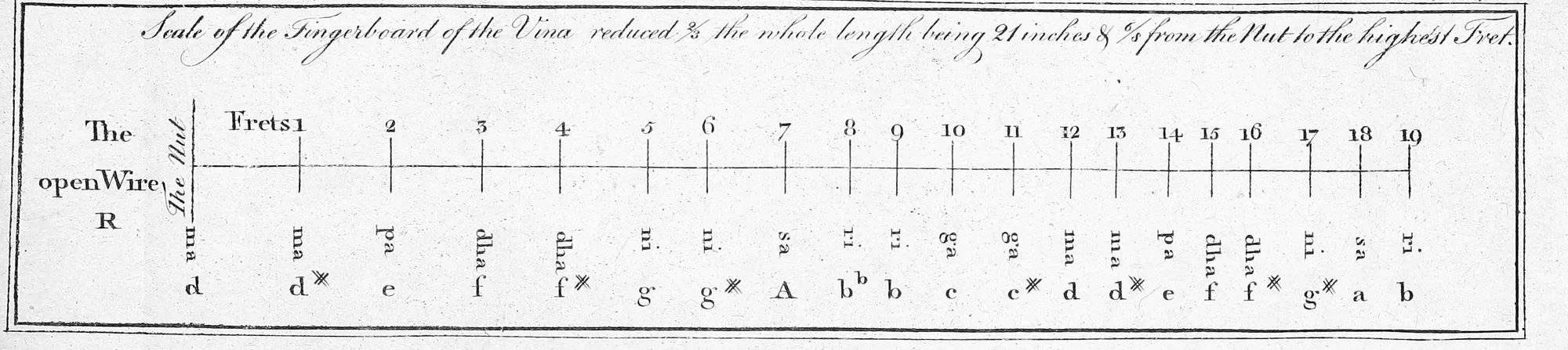
Transactions; and I now exhibit a scale of its finger board, which I received from him with the drawing of the instrument, and on the correctness of which you may confidently depend: the regular Indian gamut answers, I believe, pretty nearly to our major mode:
Ut, re, mi, fa, sol la, si, ut,
and, when the same syllables are applied to the notes, which compose our minor mode, they are distinguished by epithets expressing the change, which they suffer. It may be necessary to add, before we come to the Rágas, or modes of the Hindus, that the twenty-one múrch'hanas, which Mr. Shore's native musician confounded with the two and twenty śrutis, appear to be no more than seven species of diapason multiplied by three, according to the difference of pitch in the compass of three octaves.
Raˊga, which I translate a mode, properly signifies a passion or affection of the mind, each mode being intended, according to Bherat's definition of it, to move one or another of our simple or mixed affections; and we learn accordingly from the Náráyan, that, in the days of Crishna, there were sixteen thousand modes, each of the Gópìs at Mat'hurà chusing to sing in one of them, in order to captivate the heart of their pastoral God. The very learned Soˊma, who mixes no mythology with his accurate system of Rágas, enumerates nine hundred and sixty possible variations by the means of temperament, but selects from them, as applicable to practice, only twenty-three primary modes, from which he deduces many others; though he allows, that, by a diversity of ornament and by various contrivances, the Rágas might, like the waves of the sea, be multiplied to an infinite number. We have already observed, that eighty-four modes or manners, might naturally be formed by giving the lead to each of our twelve sounds, and varying in seven different ways the position of the semitones; but, since many of those modes would be insufferable in practice, and some would have no character sufficiently marked, the Indians appear to have retained with predilection the number indicated by nature, and to have enforced their system by two powerful aids, the association of ideas, and the mutilation of the regular scales.
Whether it had occurred to the Hindu musicians, that the velocity or slowness of sounds must depend, in a certain ratio, upon the rarefaction and condensation of the air, so that their motion must be quicker in summer than in spring or autumn, and much quicker than in winter, I cannot assure myself; but am persuaded, that their primary modes, in the system ascribed to Paˊvana,were first arranged according to the number of Indian seasons.
The year is distributed by the Hindus into six rĭtus, or seasons, each consisting of two months; and the first season, according to the Amarcósha, began with Márgaśírsha, near the time of the winter solstice, to which month accordingly we see Crishna compared in the Gítá; but the old lunar year began, I believe, with Aˊswina, or near the autumnal equinox, when the moon was at the full in the first mansion: hence the musical season, which takes the lead, includes the months of Aˊswin and Cártic, and bears the name of Sarad, corresponding with part of our autumn; the next in order are Hémanta and Siśira, derived from words, which signify frost and dew; then come Vasanta, or spring, called also Surabhi or fragrant, and Pushpasamaya, or the flower time; Gríshma, or heat; and Vershà, or the season of rain. By appropriating a different mode to each of the different seasons, the artists of India connected certain strains with certain ideas, and were able to recal the memory of autumnal merriment at the close of the harvest, or of separation and melancholy (very different from our ideas at Calcutta) during the cold months; of reviving hilarity on the appearance of blossoms, and complete vernal delight in the month of Madhu or honey; of languor during the dry heats, and of refreshment by the first rains, which cause in this climate a second spring. Yet farther: since the lunar year, by which festivals and superstitious duties are constantly regulated, proceeds concurrently with the solar year, to which the seasons are necessarily referred, devotion comes also to the aid of musick, and all the powers of nature, which are allegorically worshipped as gods and goddesses on their several holidays, contribute to the influence of song on minds naturally susceptible of religious emotions. Hence it was, I imagine, that Paˊvan, or the inventor of his musical system, reduced the number of original modes from seven to six; but even this was not enough for his purpose; and he had recourse to the five principal divisions of the day, which are the morning, noon, and evening, called trisandhya, with the two intervals between them, or the forenoon and afternoon: by adding two divisions, or intervals, of the night, and by leaving one species of melody without any such restriction, Soˊma reckons eight variations in respect of time; and the system of Paˊvan retains that number also in the second order of derivative modes. Every branch of knowledge in this country has been embellished by poetical fables; and the inventive talents of the Greeks never suggested a more charming allegory than the lovely families of the six Rágas, named, in the order of seasons above exhibited, Bhairava, Maˊlava, Sriˊraˊga, Hindˊola or Vasanta, Diˊpaca, and Meˊgha; each of whom is a Genius, or Demigod, wedded to five Ráginis, or Nymphs, and father of eight little Genii, called his Putras, or Sons: the fancy of Shakspear and the pencil of Albano might have been finely employed in giving speech and form to this assemblage of new aërial beings, who people the fairy-land of Indian imagination; nor have the Hindu poets and painters lost the advantages, with which so beautiful a subject presented them. A whole chapter of the Náráyan contains descriptions of the Rágas and their consorts, extracted chiefly from the Dámódar, the Caláncura, the Retnamálá, the Chandricà, and a metrical tract on musick ascribed to the God Naˊred himself, from which, as among so many beauties a particular selection would be very perplexing, I present you with the first that occurs, and have no doubt, that you will think the Sanscrit language equal to Italian in softness and elegance:
Lílá viháréna vanántarálé,
Chinvan prasúnáni vadhú saháyah,
Vilási vésódita divya múrtih
Srîrága ésha prat'hitah prit'hivyám.
“The demigod Sriˊraˊga, famed over all this earth, sweetly sports with his nymphs, gathering fresh blossoms in the bosom of yon grove; and his divine lineaments are distinguished through his graceful vesture.”
These and similar images, but wonderfully diversified, are expressed in a variety of measures, and represented by delicate pencils in the Rágamálàs, which all of us have examined, and among which the most beautiful are in the possession of Mr. R. Johnson and Mr. Hay. A noble work might be composed by any musician and scholar, who enjoyed leisure and disregarded expense, if he would exhibit a perfect system of Indian musick from Sanscrit authorities, with the old melodies of Soˊma applied to the songs of Jayadeˊva, embellished with descriptions of all the modes accurately translated, and with Mr. Hay's Rágamálà delineated and engraved by the scholars of Cipriani and Bartolozzi.
Let us proceed to the second artifice of the Hindu musicians, in giving their modes a distinct character and a very agreeable diversity of expression. A curious passage from Plutarch's treatise on Musick is translated and explained by Dr. Burney, and stands as the text of the most interesting chapter in his dissertation: since I cannot procure the original, I exhibit a paraphrase of his translation, on the correctness of which I can rely; but I have avoided, as much as possible, the technical words of the Greeks, which it might be necessary to explain at some length. “We are informed, says Plutarch, by Aristoxenus, that musicians ascribe to Olympus of Mysia the invention of enharmonick melody, and conjecture, that, when he was playing diatonically on his flute, and frequently passed from the highest of four sounds to the lowest but one, or conversely, skipping over the second in descent, or the third in ascent, of that series, he perceived a singular beauty of expression, which induced him to dispose the whole series of seven or eight sounds by similar skips, and to frame by the same analogy his Dorian mode, omitting every sound peculiar to the diatonick and chromatick melodies then in use, but without adding any that have since been made essential to the new enharmonick: in this genus, they say, he composed the Nome, or strain, called Spondean, because it was used in temples at the time of religious libations. Those, it seems, were the first enharmonick melodies; and are still retained by some, who play on the flute in the antique style without any division of a semitone; for it was after the age of Olympus, that the quarter of a tone was admitted into the Lydian and Phrygian modes; and it was he, therefore, who, by introducing an exquisite melody before unknown in Greece, became the author and parent of the most beautiful and affecting musick.”
This method then of adding to the character and effect of a mode by diminishing the number of its primitive sounds, was introduced by a Greek of the lower Asia, who flourished, according to the learned and accurate writer of the Travels of Anacharsis, about the middle of the thirteenth century before Christ; but it must have been older still among the Hindus, if the system, to which I now return, was actually invented in the age of Raˊma.
Since it appears from the Náráyan, that thirty-six modes are in general use, and the rest very rarely applied to practice, I shall exhibit only the scales of the six Rágas and thirty Ráginis, according to Soˊma, the authors quoted in the Náráyan, and the books explained by Pandits to Mirzaˊkhaˊn; on whose credit I must rely for that of Cacubhá, which I cannot find in my Sanscrit treatises on musick: had I depended on him for information of greater consequence, he would have led me into a very serious mistake; for he asserts, what I now find erroneous, that the graha is the first note of every mode, with which every song, that is composed in it, must invariably begin and end. Three distinguished sounds in each mode are called graha, nyása, anśa, and the writer of the Náráyan defines them in the two following couplets:
Graha swarah sa ityuctó yó gítádau samarpitah,
Nyása swarastu sa próctó yó gítádi samápticah:
Yó vyactivyanjacò gánè, yasya servé' nugáminah,
Yasya servatra báhulyam vády anśó pi nrĭpótamah.
“The note, called graha, is placed at the beginning, and that named nyása, at the end, of a song: that note, which displays the peculiar melody, and to which all the others are subordinate, that, which is always of the greatest use, is like a sovereign, though a mere anśa, or portion.” “By the word vádi, says the commentator, he means the note, which announces and ascertains the Rága, and which may be considered as the parent and origin of the graha and nyása: ” this clearly shows, I think, that the anśa must be the tonick; and we shall find, that the two other notes are generally its third and fifth, or the mediant and the dominant. In the poem entitled Mágha there is a musical simile, which may illustrate and confirm our idea:
Analpatwát pradhánatwád anśasyévétaraswaráh,
Vijigíshórnripatayah prayánti pericháratám.
“From the greatness, from the transcendent qualities, of that Hero eager for conquest, other kings march in subordination to him, as other notes are subordinate to the anśa.”
If the anśa be the tonick, or modal note, of the Hindus, we may confidently exhibit the scales of the Indian modes, according to Soˊma, denoting by an asterisk the omission of a note:
Bhairava: | dha, ni, sa, ri, ga, ma, pa. |
Varáti: | sa, ri, ga, ma, pa, dha, ni, |
Medhyamádi: | ma, pa, *, ni, sa, *, ga. |
Bhairavì: | sa, ri, ga, ma, pa, dha, ni. |
Saindhavì: | sa, ri, *, ma, pa, dha, *. |
Bengálì: | sa, ri, ga, ma, pa, dha, ni. |
Maˊlava: | ni, sa, ri, ga, ma, pa, dha. |
Tódì: | ga, ma, pa, dha, ni, sa, ri. |
Gaudi: | ni, sa, ri, *, ma, pa, *. |
Góndácrì: | sa, ri, ga, ma, pa, *, ni. |
Sust'hávatì: | not in Soˊma. |
Cacubhà: | not in Soˊma. |
Sriraˊga: | ni, sa, ri, ga, ma, pa, dha. |
Málavaśrì: | sa, *, ga, ma, pa, *, ni. |
Máravì: | ga, ma, pa, *, ni, sa, *, |
Dhanyásì: | sa, *, ga, ma, pa, * ni. |
Vasantì: | sa, ri, ga, ma, *, dha, ni. |
Asáverì: | ma, pa, dha, ni, sa, ri, ga. |
Hindoˊla: | ma, *, dha, ni, sa, *, ga. |
Rámacrì: | sa, ri, ga, ma, pa, dha, ni. |
Déśácshì: | ga, ma, pa, dha, *, sa, ri. |
Lelità: | sa, ri, ga, ma, *, dha, ni. |
Vélávalì: | dha, ni, sa, *, ga, ma, *, |
Patamanjarì: | not in Soˊma. |
Diˋpaca: | not in Soˊma. |
Déśi: | ri, *, ma, pa, dha, ni, sa. |
Cámbódì: | sa, ri, ga, ma, pa, dha, *. |
Nettà: | sa, ri, ga, ma, pa, dha, ni. |
Cédárì: | ni, sa, ri, ga, ma, pa, dha. |
Carnátì: | ni, sa, *, ga, ma, pa, * |
Meˊgha: | not in Soˊma. |
Taccà: | sa, ri, ga, ma, pa, dha, ni. |
Mellárì: | dha, *, sa, ri, *, ma, pa. |
Gurjarì: | ri, ga, ma, *, dha, ni, sa, |
Bhúpálì: | ga, *, pa, dha, *, sa, ri. |
Désacrì: | sa, ri, ga, ma, pa, dha, ni. |
It is impossible, that I should have erred much, if at all, in the preceding table, because the regularity of the Sanscrit metre has in general enabled me to correct the manuscript; but I have some doubt as to Vélávali, of which pa is declared to be the anśa, or tonick, though it is said in the same line, that both pa and ri may be omitted: I, therefore, have supposed dha to be the true reading, both Mirzakhan and the Náráyan exhibiting that note as the leader of the mode. The notes printed in Italick letters are variously changed by temperament or by shakes and other graces; but, even if I were able to give you in words a distinct notion of those changes, the account of each mode would be insufferably tedious, and scarce intelligible without the assistance of a masterly performer on the Indian lyre. According to the best authorities adduced in the Náráyan, the thirty-six modes are, in some provinces, arranged in these forms:
Bhairava: | dha, ni, sa, ri, ga, ma, pa, |
Varátì: | sa, ri, ga, ma, pa, dha, ni. |
Medhyamádi: | ni, sa, *, ga, ma, pa, dha. |
Bhairavì: | sa, *, ga, ma, *, dha, ni, |
Saindhavì: | pa, dha, ni, sa, ri, ga, ma, |
Bengálì: | sa, ri, ga, ma, pa, dha, ni. |
Maˊlava: | ma, *, dha, ni, sa, ri, ga. |
Tódì: | ma, pa, dha, ni, sa, ri, ga. |
Gaudì: | ni, sa, ri, ga, ma, *, dha. |
Gondacrì: | sa, *, ga, ma, pa, *, ni. |
Sust'hávatì: | dha, ni, sa, ri, ga, ma, *. |
Cacubhà: | not in the Náráyan. |
Sriˊraˊga: | sa, ri, ga. ma, pa, dha, ni. |
Málavasrì: | sa, ri, ga, ma, pa, dha, ni. |
Máravì: | sa, *, ga, ma, pa, dha, ni. |
Dhanyási: | sa, ri, ga, ma, pa, dha, ni. |
Vasantì: | sa, ri, ga, ma, pa, dha, ni. |
Aˊsáverì: | ri, ga, ma, pa, dha, ni, sa. |
Hindoˊla: | sa, *, ga, ma, *, dha, ni, |
Rámacrì: | sa, ri, ga, ma, pa, dha, ni. |
Désácshì: | ga, ma, pa, dha, ni, sa, *. |
Lelità: | sa, *, ga, ma, pa, *, ni. |
Vélávalì: | dha, ni, sa, ri, ga, ma, pa. |
Patamanjarì: | pa, dha, ni, sa, ri, ga, ma. |
Diˊpaca: | omitted. |
Désì: | ni, sa, ri, ga, ma, pa, dha. |
Cámbódì: | sa, ri, ga, ma, pa, dha, ni. |
Nettà: | sa, ri, ga, ma, pa, dha, ni. |
Cédárì: | omitted. |
Carnaˊtì: | ni, sa, ri, ga, ma, pa, dha. |
Meˊgha: | dha, ni, sa, ri, ga, ma, pa. |
Taccà: | (a mixed mode.) |
Mellári: | dha, ni, *, ri, ga, ma, *. |
Gurjarì: | omitted in the Náráyan. |
Bhúpálì: | sa, ri, ga, *, pa, dha, *. |
Désacrì: | ni, sa, *, ga, ma, pa, *. |
Among the scales just enumerated we may safely fix on that of Sriˊraˊga for our own major mode, since its form and character are thus described in a Sanscrit couplet:
Játinyásagrahagrámáṅśéshu shadjò' lpapanchamah,
Sringáravírayórjṅéyah Srîrâgò gítacóvidaih.
“Musicians know Srírága to have sa for its principal note and the first of its scale, with pa diminished, and to be used for expressing heroick love and valour.” Now the diminution of pa by one śruti gives us the modern European scale,
ut, re, mi, fa, sol, la, si, ut,
with a minor tone, or, as the Indians would express it, with three śrutis, between the fifth and sixth notes.
On the formulas exhibited by Miˊrzakhaˊn I have less reliance; but, since he professes to give them from Sanscrit authorities, it seemed proper to transcribe them:
Bhairava: | dha, ni, sa, *, ga, ma, *. |
Varáti: | sa, ri, ga, ma, pa, dha, ni. |
Medhyamádi: | ma, pa, dha, ni, sa, ri, ga. |
Bhairavì: | ma, pa, dha, ni, sa, ri, ga. |
Saindhavì: | sa, ri, ga, ma, pa, dha, ni. |
Bengálì: | sa, ri, ga, ma, pa, dha, ni. |
Maˊlava: | sa, ri, ga, ma, pa, dha, ni. |
Tódì: | sa, ri, ga, ma, pa, dha, ni. |
Gaúdì: | sa, *, ga, ma, *, dha, ni. |
Góndacrì: | ni, sa, *, ga, ma, pa, *. |
Sust'hávati: | dha, ni, sa, ri, ga, ma, *. |
Cacubhà: | dha, ni, sa, ri, ga, ma, pa. |
Sriˊraˊga: | sa, ri, ga, ma, pa, dha, ni. |
Málavasrì: | sa, ri, ga, ma, pa, dha, ni. |
Máravì: | sa, *, pa, ga, ma, dha, ni. |
Dhanyásì: | sa, pa, dha, ni, ri, ga, *. |
Vasantì: | sa, ri, ga, ma, pa, dha, ni. |
Aˊsáverì: | dha, ni, sa, *, *, ma, pa. |
Hindola: | sa, *, ga, ma, pa, *, ni. |
Rámacrì: | sa, *, ga, ma, pa, *, ni. |
Déśácshí: | ga, ma, pa, dha, ni, sa, *. |
Lelità: | dha, ni, sa, *, ga, ma, *. |
Vélavalì: | dha, ni, sa, ri, ga, ma, pa. |
Patamanjarì | pa, dha, ni, sa, ri, ga, ma. |
Dipaca: | sa, ri, ga, ma, pa, dha, ni. |
Désì: | ri, ga, ma, *, dha, ni, sa. |
Cambódi: | dha, ni, sa, ri, ga, ma, pa. |
Netta: | sa, ni, dha, pa, ma, ga, ri. |
Cédari: | ni, sa, *, ga, ma, pa, *. |
Carnati: | ni, sa, ri, ga, ma, pa, dha. |
Megha: | dha, ni, sa, ri, ga, *, *. |
Tacca: | sa, ri, ga, ma, pa, dha, ni. |
Mellari: | dha, ni, *, ri, ga, ma, *. |
Gurjari: | ri, ga, ma, pa, dha, ni, sa. |
Bhúpali: | sa, ga, ma, dha, ni, pa, ri. |
Désacri: | sa, ri, ga, ma, pa, dha, ni. |
It may reasonably be suspected, that the Moghol writer could not have shown the distinction, which must necessarily have been made, between the different modes, to which he assigns the same formula; and, as to his inversions of the notes in some of the Ráginis, I can only say, that no such changes appear in the Sanscrit books, which I have inspected. I leave our scholars and musicians to find, among the scales here exhibited, the Dorian mode of Olympus; but it cannot escape notice, that the Chinese scale C, D, E, *, G, A, *, corresponds very nearly with ga, ma, pa, * ni, sa, * or the Máravì of Soma: we have long known in Bengal, from the information of a Scotch gentleman skilled in musick, that the wild, but charming, melodies of the ancient highlanders were formed by a similar mutilation of the natural scale. By such mutilations, and by various alterations of the notes in tuning the Vínà, the number of modes might be augmented indefinitely; and Callinaˊt'ha, admits ninety into his system, allowing six nymphs, instead of five, to each of his musical deities: for Dípaca, which is generally considered as a lost mode, (though Miˊrzaˊkhan exhibits the notes of it) he substitutes Panchama; for Hindóla, he gives us Vasanta, or the Spring; and for Málava, Natanáráyan or Crishna the Dancer; all with scales rather different from those of Paˊvan. The system of Iswara, which may have had some affinity with the old Egyptian musick invented or improved by Osiris, nearly resembles that of Hanumat; but the names and scales are a little varied: in all the systems, the names of the modes are significant, and some of them as fanciful as those of the fairies in the Midsummer Night's Dream. Forty-eight new modes were added by Bherat, who marries a nymph, thence called Bháryà, to each Putra, or Son, of a Rága; thus admitting, in his musical school, an hundred and thirty-two manners of arranging the series of notes.
Had the Indian empire continued in full energy for the last two thousand years, religion would, no doubt, have given permanence to systems of musick invented, as the Hindus believe, by their Gods, and adapted to mystical poetry: but such have been the revolutions of their government since the time of Alexander, that, although the Sanscrit books have preserved the theory of their musical composition, the practice of it seems almost wholly lost (as all the Pandits and Rájas confess) in Gaur and Magadha, or the provinces of Bengal and Behar. When I first read the songs of Jayadeˊva, who has prefixed to each of them the name of the mode, mode in which it was anciently sung, I had hopes of procuring the original musick; but the Pandits of the south referred me to those of the west, and the Bráhmens of the west would have sent me those of the north; while they, I mean those of Népàl and Cashmír, declared that they had no ancient musick, but imagined, that the notes to the Gítagóvinda must exist, if any where, in one of the southern provinces, where the Poet was born: from all this I collect, that the art, which flourished in India many centuries ago, has faded for want of due culture; though some scanty remnants of it may, perhaps, be preserved in the pastoral roundelays of Mat'hurà on the loves and sports of the Indian Apollo. We must not, therefore, be surprised, if modern performers on the Vínà have little or no modulation, or change of mode, to which passionate musick owes nearly all its enchantment; but that the old musicians of India, having fixed on a leading mode to express the general character of the song, which they were translating into the musical language, varied that mode, by certain rules, according to the variation of sentiment or passion in the poetical phrases, and always returned to it at the close of the air, many reasons induce me to believe; though I cannot but admit, that their modulation must have been greatly confined by the restriction of certain modes to certain seasons and hours, unless those restrictions belonged merely to the principal mode. The scale of the Vínà, we find, comprized both our European modes, and, if some of the notes can be raised a semitone by a stronger pressure on the frets, a delicate and experienced finger might produce the effect of minute enharmonick intervals: the construction of the instrument, therefore, seems to favour my conjecture; and an excellent judge of the subject informs us, that “the open wires are from time to time struck in a manner, that prepares the ear for a change of modulation, to which the uncommonly full and fine tones of those notes greatly contribute.” We may add, that the Hindu poets never fail to change the metre, which is their mode, according to the change of subject or sentiment in the same piece; and I could produce instances of poetical modulation (if such a phrase may be used) at least equal to the most affecting modulations of our greatest composers: now the musician must naturally have emulated the poet, as every translator endeavours to resemble his original; and, since each of the Indian modes is appropriated to a certain affection of the mind, it is hardly possible, that, where the passion is varied, a skilful musician could avoid a variation of the mode. The rules for modulation seem to be contained in the chapters on mixed modes, for an intermixture of Mellárì with Tódì and Saindhavì means, I suppose, a transition, however short, from one to another: but the question must remain undecided, unless we can find in the Sangítas a clearer account of modulation, than I am able to produce, or unless we can procure a copy of the Gítagóvinda with the musick, to which it was set, before the time of Calidas, in some notation, that may be easily decyphered. It is obvious, that I have not been speaking of a modulation regulated by harmony, with which the Hindus, I believe, were unacquainted; though, like the Greeks, they distinguish the consonant and dissonant sounds: I mean only such a transition from one series of notes to another, as we see described by the Greek musicians, who were ignorant of harmony in the modern sense of the word, and, perhaps, if they had known it ever so perfectly, would have applied it solely to the support of melody, which alone speaks the language of passion and sentiment.
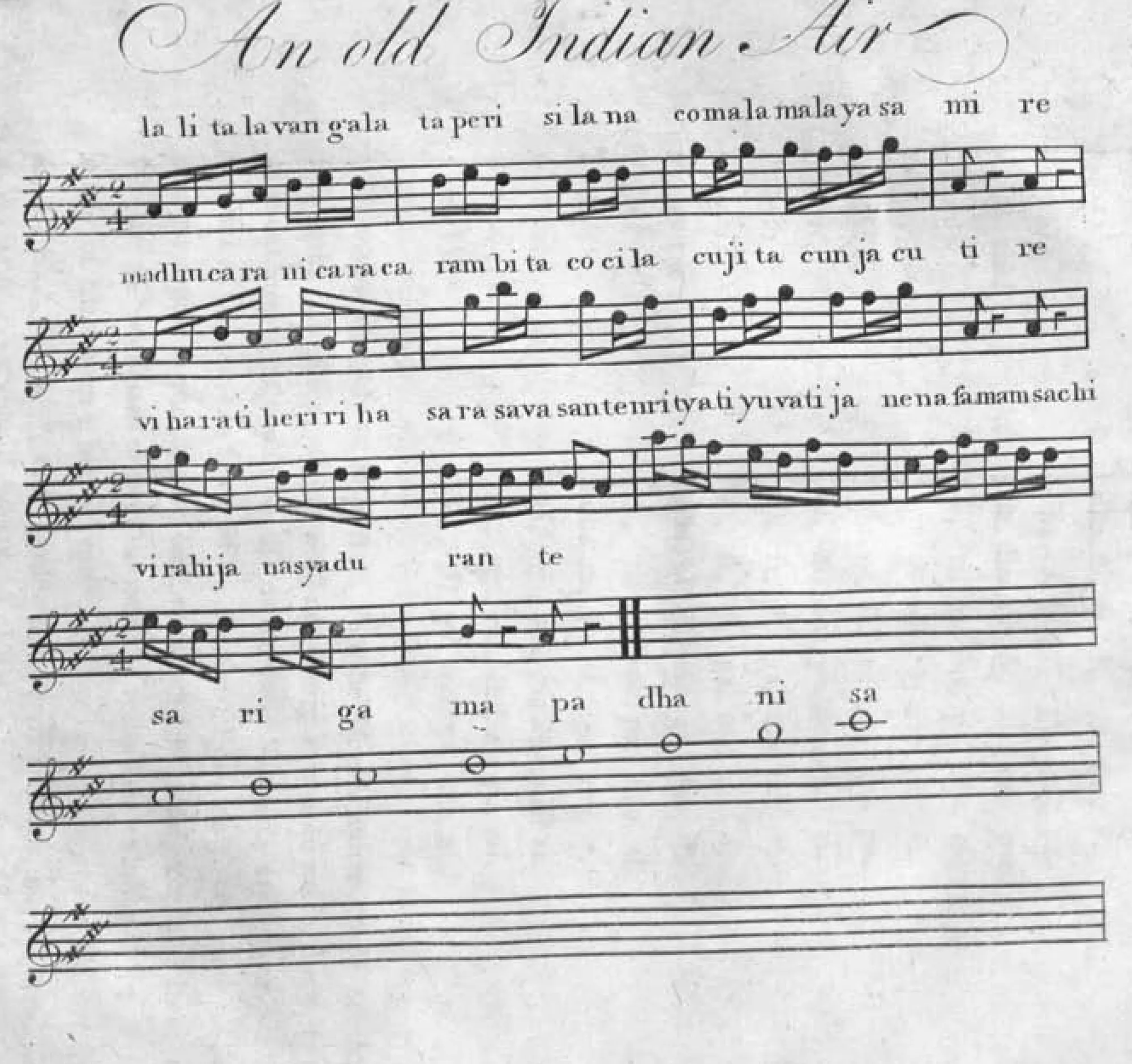
It would give me pleasure to close this essay with several specimens of old Indian airs from the fifth chapter of Soˊma; but I have leisure only to present you with one of them in our own characters accompanied with the original notes: I selected the mode of Vasanta, because it was adapted by Jayadeˊva himself to the most beautiful of his odes, and because the number of notes in Soˊma compared with that of the syllables in the Sanscrit stanza, may lead us to guess, that the strain itself was applied by the musician to the very words of the poet. The words are:
Lalita lavanga latá perisílana cómala malaya samíré,
Madhućara nicara carambita cócila cújita cunja cutíré,
Viharati heririha sarasa vasanté,
Nrĭtyati yuvati janéna samaṅ sac'hi virahi janasya duranté.
“While the soft gale of Malaya wafts perfume from the beautiful clove-plant, and the recess of each flowery arbour sweetly resounds with the strains of the Cócila mingled with the murmurs of the honey making swarms, Heri dances, O lovely friend, with a company of damsels in this vernal season; a season full of delights, but painful to separated lovers.”
I have noted Soˊma's air in the major mode of A, or sa, which, from its gaiety and brilliancy, well expresses the general hilarity of the song; but the sentiment of tender pain, even in a season of delights, from the remembrance of pleasures no longer attainable, would require in our musick a change to the minor mode; and the air might be disposed in the form of a rondeau ending with the second line, or even with the third, where the sense is equally full, if it should be thought proper to express by another modulation that imitative melody, which the poet has manifestly attempted: the measure is very rapid, and the air should be gay, or even quick, in exact proportion to it.
The annexed plate contains also a strain in the mode of Hindoˊla, beginning and ending with the fifth note sa, but wanting pa, and ri, or the
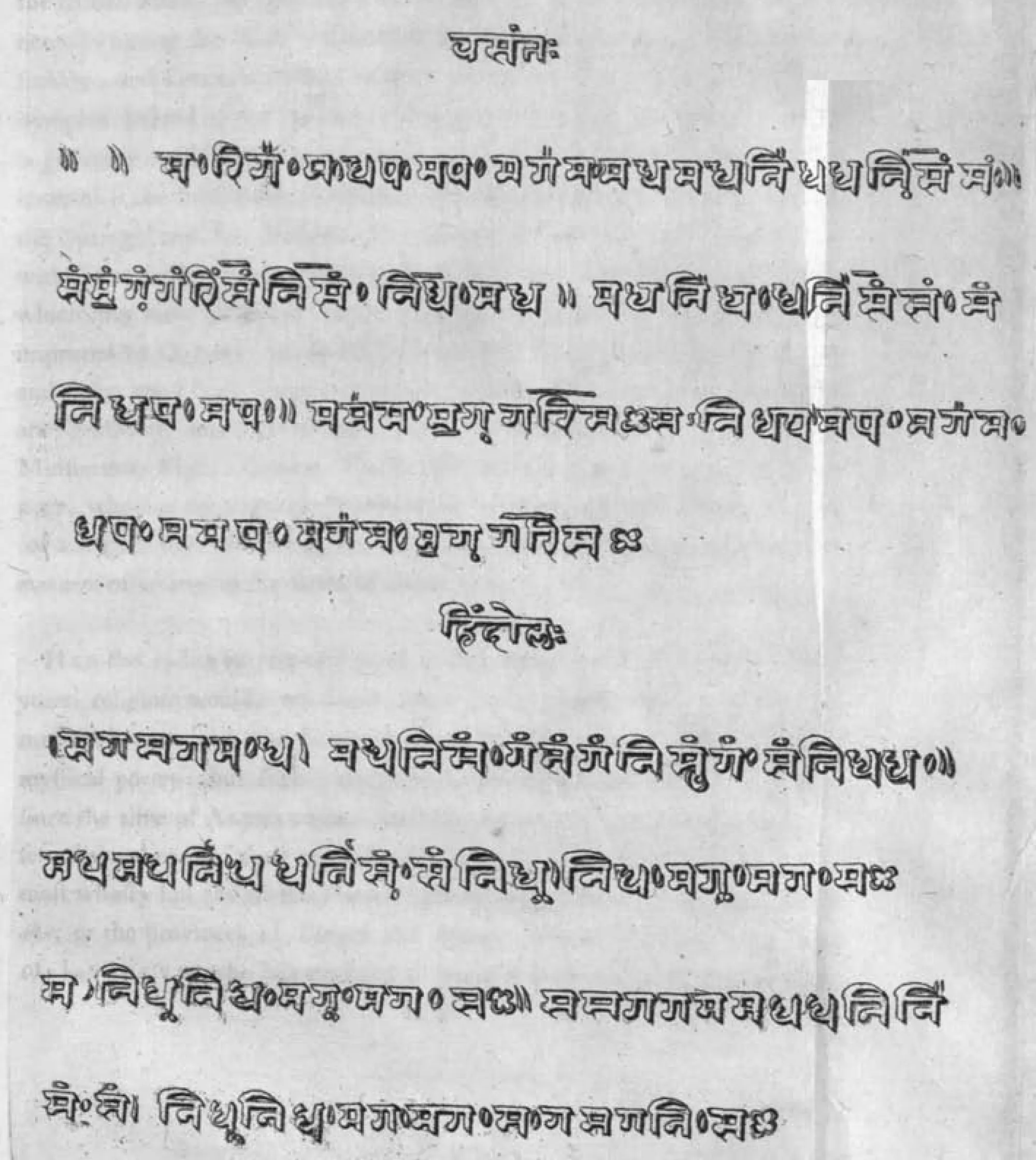
second and sixth: I could easily have found words for it in the Gítagôvinda, but the united charms of poetry and musick would lead me too far; and I must now with reluctance bid farewel to a subject, which I despair of having leisure to resume.