On the Second Classical Book of the Chinese
The vicinity of China to our Indian territories, from the capital of which there are not more than six hundred miles to the province of Yuˊnaˊn, must necessarily draw our attention to that most ancient and wonderful Empire, even if we had no commercial intercourse with its more distant and maritime provinces; and the benefits, that might be derived from a more intimate connexion with a nation long famed for their useful arts and for the valuable productions of their country, are too apparent to require any proof or illustration. My own inclinations and the course of my studies lead me rather to consider at present their laws, politicks, and morals, with which their general literature is closely blended, than their manufactures and trade; nor will I spare either pains or expense to procure translations of their most approved law-tracts; that I may return to Europe with distinct ideas, drawn from the fountain-head, of the wisest Asiatick legislation. It will probably be a long time before accurate returns can be made to my inquiries concerning the Chinese Laws; and, in the interval, the Society will not, perhaps, be displeased to know, that a translation of a most venerable and excellent work may be expected from Canton through the kind assistance of an inestimable correspondent.
According to a Chinese Writer, named Li Yang Ping, ‘the ancient characters used in his country were the outlines of visible objects earthly and celestial; but, as things merely intellectual could not be expressed by those figures, the grammarians of China contrived to represent the various operations of the mind by metaphors drawn from the productions of nature: thus the idea of roughness and of rotundity, of motion and rest, were conveyed to the eye by signs representing a mountain, the sky, a river and the earth; the figures of the sun, the moon, and the stars, differently combined, stood for smoothness and splendour, for any thing artfully wrought, or woven with delicate workmanship; extension, growth, increase, and many other qualities were painted in characters taken from clouds, from the firmament, and from the vegetable part of the creation; the different ways of moving, agility and slowness, idleness and diligence, were expressed by various insects, birds, fish, and quadrupeds: in this manner passions and sentiments were traced by the pencil, and ideas not subject to any sense were exhibited to the sight; until by degrees new combinations were invented, new expressions added; the characters deviated imperceptibly from their primitive shape, and the Chinese language became not only clear and forcible, but rich and elegant in the highest degree.’
In this language, so ancient and so wonderfully composed, are a multitude of books abounding in useful, as well as agreeable, knowledge; but the highest class consists of Five works; one of which at least every Chinese, who aspires to literary honours, must read again and again, until he possess it perfectly.
The first is purely Historical, containing annals of the empire from the two thousand-three hundred-thirty seventh year before Christ: it is entitled Shuˊking, and a version of it has been published in France; to which country we are indebted for the most authentick and most valuable specimens of Chinese History and Literature, from the compositions, which preceded those of Homer, to the poetical works of the present Emperor, who seems to be a man of the brightest genius and the most amiable affections. We may smile, if we please, at the levity of the French, as they laugh without scruple at our seriousness; but let us not so far undervalue our rivals in arts and in arms, as to deny them their just commendation, or to relax our efforts in that noble struggle, by which alone we can preserve our own eminence.
The Second Classical work of the Chinese contains three hundred Odes, or short Poems, in praise of ancient sovereigns and legislators, or descriptive of ancient manners, and recommending an imitation of them in the discharge of all publick and domestick duties: they abound in wise maxims, and excellent precepts, ‘their whole doctrine, according to Cun-fu-tsu, in the Luˊnyuˊ or Moral Discourses, being reducible to this grand rule, that we should not even entertain a thought of any thing base or culpable;’ but the copies of the Shiˊ King, for that is the title of the book, are supposed to have been much disfigured, since the time of that great Philosopher, by spurious passages and exceptionable interpolations; and the style of the Poems is in some parts too metaphorical, while the brevity of other parts renders them obscure; though many think even this obscurity sublime and venerable, like that of ancient cloysters and temples, ‘Shedding, as Milton expresses it, a dim religious light.’ There is another passage in the Luˊnyuˊ, which deserves to be set down at length: ‘Why, my sons, do you not study the book of Odes? If we creep on the ground, if we lie useless and inglorious, those poems will raise us to true glory: in them we see, as in a mirror, what may best become us, and what will be unbecoming; by their influence we shall be made social, affable, benevolent; for, as musick combines sounds in just melody, so the ancient poetry tempers and composes our passions: the Odes teach us our duty to our parents at home, and abroad to our prince; they instruct us also delightfully in the various productions of nature.’ ‘Hast thou studied, said the Philosopher to his son Peyu, the first of the three hundred Odes on the nuptials of Prince Veˊnvaˊm and the virtuous Tai Jin? He, who studies them not, resembles a man with his face against a wall, unable to advance a step in virtue and wisdom.’ Most of those Odes are near three thousand years old, and some, if we give credit to the Chinese annals, considerably older; but others are somewhat more recent, having been composed under the later Emperors of the third family, called Sheu. The work is printed in four volumes; and, towards the end of the first, we find the Ode, which Couplet has accurately translated at the beginning of the Taˊ hio, or Great Science, where it is finely amplified by the Philosopher: I produce the original from the Shiˊ King itself, and from the book, in which it is cited, together with a double version, one verbal and another metrical; the only method of doing justice to the poetical compositions of the Asiaticks. It is a panegyrick on Vucuˊn, Prince of Guey in the province of Honang, who died, near a century old, in the thirteenth year of the Emperor Pingvang, seven hundred and fifty-six years before the birth of Christ, or one hundred and forty-eight, according to Sir Isaac Newton, after the taking of Troy, so that the Chinese Poet might have been contemporary with Hesiod and Homer, or at least must have written the Ode before the Iliad and Odyssey were carried into Greece by Lycurgus.
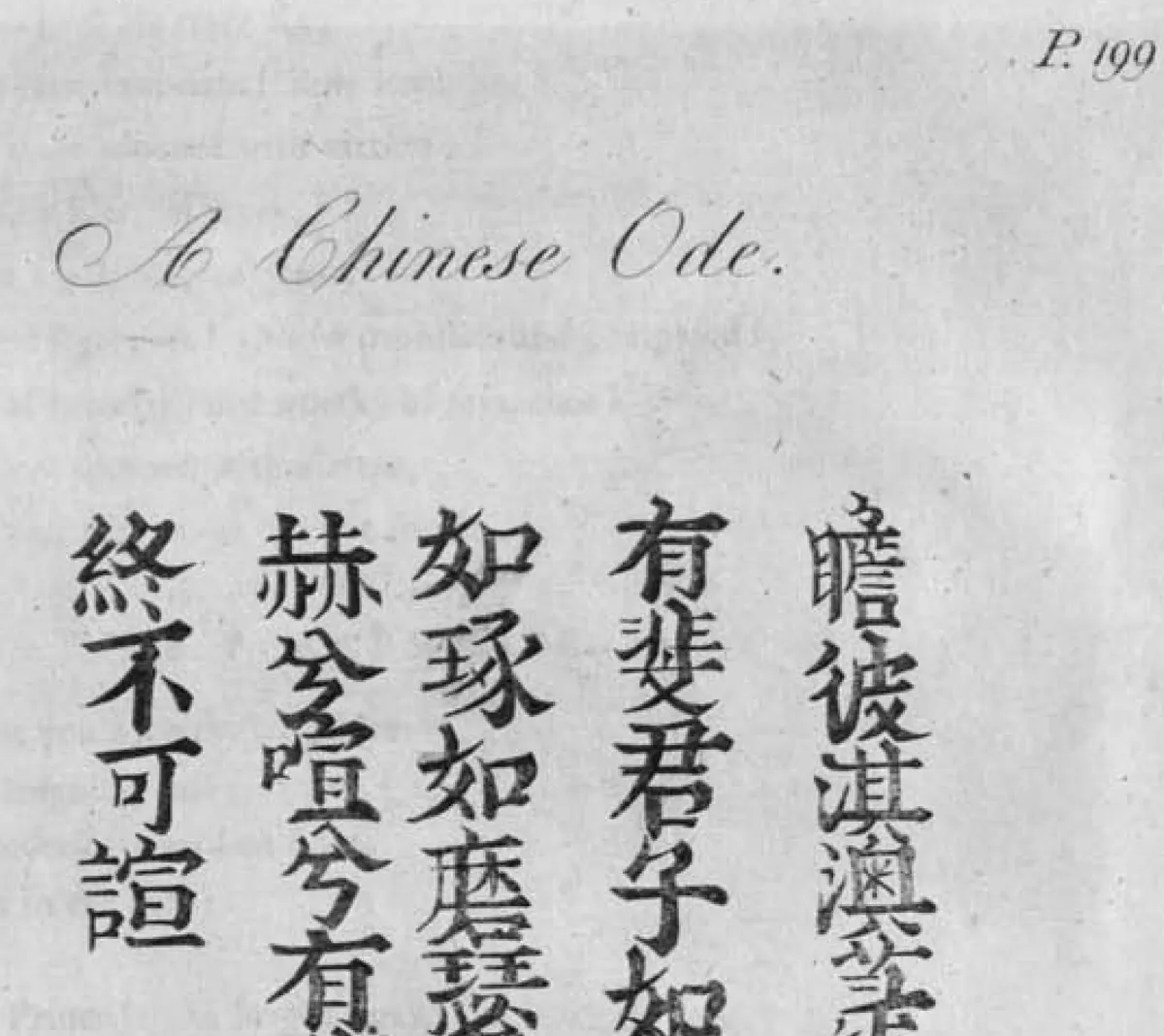
The verbal translation of the thirty-two original characters is this:
‘Behold1 yon2 reach4 of the river Ki3;
‘Its green5 reeds6 how luxuriant7! how luxuriant8!
‘Thus is9 our1112 Prince adorned10 with virtues;
‘As13 a carver14, as15 a filer16, of ivory,
‘As17 a cutter18, as19 a polisher20, of gems.
‘O how elate21 and sagacious! O how dauntless22 and composed!
‘How worthy23 of fame! How worthy24 of reverence!
‘We25 have a2728 Prince adorned26 with virtues,
‘Whom to the end29 of time30 we can31 not32 forget.
The PARAPHRASE.
Behold, where yon blue riv'let glides
Along the laughing dale;
Light reeds bedeck its verdant sides,
And frolick in the gale:So shines our Prince! In bright array
The Virtues round him wait;
And sweetly smil'd th' auspicious day,
That rais'd Him o'er our State.As pliant hands in shapes refin'd
Rich iv'ry carve and smoothe,
His Laws thus mould each ductile mind,
And every passion soothe.
In sparkling ranks to beam,
With Manners thus he forms the heart,
And spreads a gen'ral gleam.What soft, yet awful, dignity!
What meek, yet manly, grace!
What sweetness dances in his eye,
And blossoms in his face!So shines our Prince! A sky-born crowd
Of Virtues round him blaze:
Ne'er shall Oblivion's murky cloud
Obscure his deathless praise.
The prediction of the Poet has hitherto been accomplished; but he little imagined, that his composition would be admired, and his Prince celebrated in a language not then formed, and by the natives of regions so remote from his own.
In the tenth leaf of the Taˊ Hio a beautiful comparison is quoted from another Ode in the Shiˊ King, which deserves to be exhibited in the same form with the preceding:
‘The peach-tree1, how fair2! how graceful3!
‘Its4 leaves5, how blooming6! how pleasant7!
‘Such is a8 bride9, when10 she enters11 her bridegroom's house,
‘And pays12 due attention to her13 whole14 family15.’
The simile may thus be rendered:
Gay child of Spring, the garden's queen,
Yon peach-tree charms the roving sight:
Its fragrant leaves how richly green!
Its blossoms how divinely bright!So softly smiles the blooming bride
By love and conscious Virtue led
O'er her new mansion to preside,
And placid joys around her spread.
The next leaf exhibits a comparison of a different nature, rather sublime than agreeable, and conveying rather censure than praise:
O1 how horridly impends yon2 southern3 mountain4!
Its5 rocks6 in how vast, how rude7 a8 heap!
Thus loftily9 thou sittest10, O minister11 of YN12;
All14 the people13 look up to thee15 with dread16.
Which may be thus paraphrased:
See, where yon crag's imperious height
The sunny highland crowns,
And, hideous as the brow of night,
Above the torrent frowns!So scowls the Chief, whose will is law,
Regardless of our state;
While millions gaze with painful awe,
With fear allied to hate.
It was a very ancient practice in China to paint or engrave moral sentences and approved verses on vessels in constant use; as the words Renew Thyself Daily were inscribed on the bason of the Emperor Tang, and the poem of Kien Long, who is now on the throne, in praise of Tea, has been published on a set of porcelain cups; and, if the description just cited of a selfish and insolent statesman were, in the same manner, constantly presented to the eyes and attention of rulers, it might produce some benefit to their subjects and to themselves; especially if the comment of Tsem Tsu, who may be called the Xenophon, as Cun Fuˊ Tsuˊ was the Socrates, and Mem Tsu the Plato, of China, were added to illustrate and enforce it.
If the rest of the three hundred Odes be similar to the specimens adduced by those great moralists in their works, which the French have made publick, I should be very solicitous to procure our nation the honour of bringing to light the second Classical book of the Chinese. The third, called Yeking, or the book of Changes, believed to have been written by Fo, the Hermes of the East, and consisting of right lines variously disposed, is hardly intelligible to the most learned Mandarins; and Cun Fuˊ Tsuˊ himself, who was prevented by death from accomplishing his design of elucidating it, was dissatisfied with all the interpretations of the earliest commentators. As to the fifth, or Liki, which that excellent man compiled from old monuments, it consists chiefly of the Chinese ritual, and of tracts on Moral Duties; but the fourth entitled Chung Cieu, or Spring and Autumn, by which the same incomparable writer meaned the flourishing state of an Empire, under a virtuous monarch, and the fall of kingdoms, under bad governors, must be an interesting work in every nation. The powers, however, of an individual are so limited, and the field of knowledge is so vast, that I dare not promise more, than to procure, if any exertions of mine will avail, a complete translation of the Shiˊ King, together with an authentick abridgement of the Chinese Laws, civil and criminal. A native of Canton, whom I knew some years ago in England, and who passed his first examinations with credit in his way to literary distinctions, but was afterwards allured from the pursuit of learning by a prospect of success in trade, has favoured me with the Three Hundred Odes in the original, together with the Luˊn Yuˊ, a faithful version of which was published at Paris near a century ago; but he seems to think, that it would require three or four years to complete a translation of them; and Mr. Cox informs me, that none of the Chinese, to whom he has access, possess leisure and perseverance enough for such a task; yet he hopes, with the assistance of Whang Atong, to send me next season some of the poems translated into English. A little encouragement would induce this young Chinese to visit India, and some of his countrymen would, perhaps, accompany him; but, though considerable advantage to the publick, as well as to letters, might be reaped from the knowledge and ingenuity of such emigrants, yet we must wait for a time of greater national wealth and prosperity, before such a measure can be formally recommended by us to our patrons at the helm of government.